Astrophotographer Andrew McCarthy presents a stunning view of the M27 nebula, revealing what the future holds for our sun after its lifecycle.
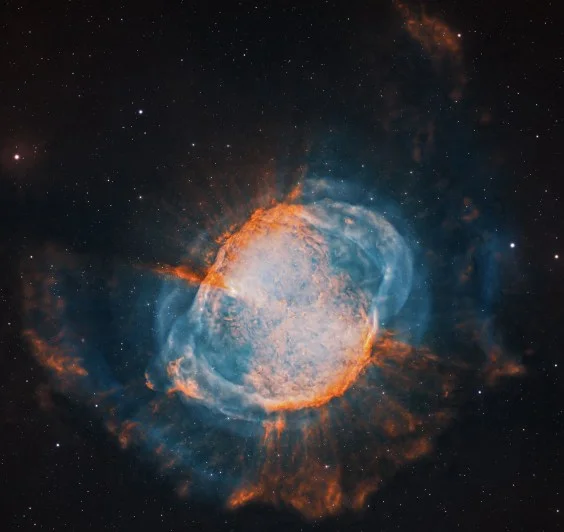
Envision the sun five billion years from now: it could resemble the Messier 27 (M27) planetary nebula, also termed the Dumbbell Nebula. This expansive cloud of gas and dust has been expelled by a dying star, illuminated by the remnants of its fading glow.
Capturing Cosmic Beauty
Astrophotographer Andrew McCarthy dedicated over 30 hours across multiple nights to capture this remarkable image, carefully timing his shots to dodge the interference of both our planet and the sun. Such dedication is emblematic of modern astrophotography, where achieving clarity involves complex planning and considerable patience. Astrophotographers often battle not just the cosmos but the terrestrial elements, making McCarthy's achievement a testament to both skill and perseverance.
Methodology and Artistic Choices
In his newsletter, McCarthy detailed his methodology: “I cycled through hydrogen-, oxygen-, and sulfur-tuned filters to isolate the trace gases in the nebula, and then mapped those separate photos to corresponding color channels to create the color photo.” This process involves a high level of technical precision and a deep understanding of both the equipment and the astrophysical phenomena at play. The color mapping, while rooted in scientific acquisition, also reflects a choice that balances technical accuracy with artistic expression in his final collage.
The nebula's vibrant hues showcase the “star smoke” consisting of oxygen (depicted in blue) alongside hydrogen and sulfur (in shades of orange), with denser zones appearing more pronounced. These colored gases are not just for aesthetics; they play significant roles in the cosmic recycling process. Elements expelled by dying stars undergo reincorporation into new stellar bodies, perpetuating a cycle that’s fundamental to our universe's chemistry. This visual representation serves as both a beautiful image and a reminder of the interconnected nature of cosmic evolution.
“When it comes to color in astrophotos, there is a level of artistic interpretation involved,” McCarthy remarked. “While this one features false color based on how the image was captured, it’s not too distant from the actual colors, where the oranges lean towards a more crimson hue.” This nuanced commentary fosters a deeper appreciation—understanding that while some colors are rendered artificially, they strive to remain true to the actual cosmic scene. Here’s the thing: many viewers might not realize how closely art and science align in this domain.
The Lifecycle of Stars
The lifecycle of a star similar to our sun culminates in dramatic fashion. When it begins to deplete its hydrogen reserves, it expands into a red giant. This phase for the sun will likely engulf Mercury, Venus, and perhaps Earth, posing a serious survival challenge for humanity, if we’re still around. The implications of this transformation pose existential questions, sparking curiosity and concern about our long-term future in the universe. If you’re working in this space, pondering humanity's fate is as influential as any scientific inquiry.
As the star's outer layers are expelled into space, it loses a significant portion of its mass, resulting in a hot, small white dwarf star. This starkly contrasts with the tumultuous red giant phase. McCarthy’s image beautifully captures this white dwarf, a phenomenon that reaches peak temperatures exceeding 85,000 Kelvin (approximately 152,540°F), while our sun operates at a relatively cooler 5,800 Kelvin (around 9,980°F) on the surface. Such stark differences in temperature point to the violent transformation and the brewing stellar remnants that shape nebulae.
The dramatic illumination from the white dwarf produces a breathtaking visual, but this light display is short-lived—lasting roughly 25,000 years—and eventually, the white dwarf will cool over billions of years. The image of the nebula, therefore, represents just a fleeting moment in a much larger timeline of cosmic evolution, often overlooked by the casual observer.
The Discovery and Ongoing Fascination
Situated about 1,360 light-years away in the constellation Vulpecula, M27 holds the distinction of being the first planetary nebula discovered, identified by French astronomer Charles Messier in 1764. A mere oval smudge back then, today's technology offers us an exquisite and colorful glimpse into its beauty. The evolution of both observational technology and our understanding of cosmic phenomena cannot be overstated. What once appeared as basic observations are now transformed into vibrant visual journeys through time and space.
Future Outlook: Cosmic Connections
The implications of McCarthy's work go beyond mere aesthetics. It raises significant questions about our understanding of stellar processes and their broader connections in the universe. The way we interpret these images can influence public interest in astronomy and the scientific community’s ability to communicate complex ideas.
Looking ahead, continued advancements in imaging technology promise to enhance our understanding of nebulae like M27. As amateur and professional astronomers alike contribute to this field, it may inspire a new generation of scientists and astrophotographers. Perhaps next time you glance at such celestial photographs, remember there's more than meets the eye. Keep an eye out for how these images can spark deeper dialogues about our place in the cosmos.
Enjoying Nautilus? Subscribe to our free newsletter.
Lead Image: Andrew McCarthy
Discussion
Sign in to join the discussion.