Andy Jassy highlights the importance of asking questions and discusses the competitive landscape of AI during his talk at Harvard Business School.
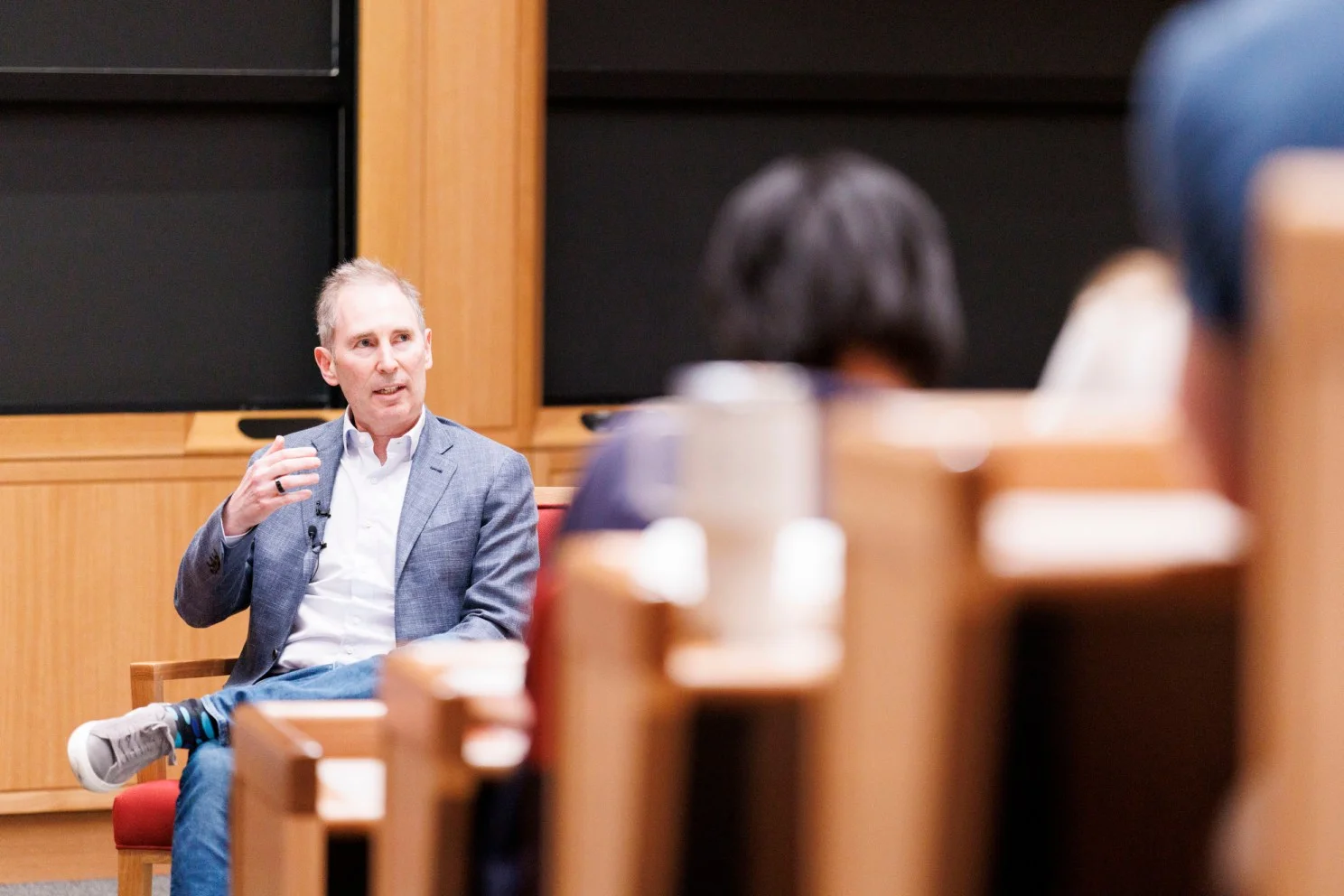
While Amazon is widely recognized for its e-commerce and streaming services, it is also pivotal in the evolution of artificial intelligence. Recently, the tech giant's valuation soared to an impressive $3 trillion, a milestone largely influenced by its cloud computing wing, Amazon Web Services (AWS). AWS serves as a crucial foundation for significant AI players, including Anthropic and OpenAI, as well as smaller firms working on more accessible AI solutions.
In a recent dialogue at Harvard Business School, CEO Andy Jassy shared insights into the future trajectory of AI. He countered the notion of a single model dominating the market. “There is not one tool to rule the world — it never works out that way,” Jassy explained. “Customers always want choice, and most sophisticated generative AI applications today leverage multiple models.”
“There is not one tool to rule the world — it never works out that way.”
Andy Jassy
Looking at the competitive landscape, Jassy predicts the emergence of six to eight key AI models, each with unique strengths across various applications. While some may excel in specific areas, all will meet the demands for intelligence, cost efficiency, accessibility, and safety.
However, challenges remain. One significant hurdle is the high cost associated with AI inference—the process of training models for accurate predictions and decisions. Despite recent declines in costs, Jassy argues they're still “too high,” primarily due to expensive computing chips. Amazon is actively addressing this with plans for its own budget-friendly AI accelerator chips.
Reflecting on his career trajectory, Jassy recounted joining Amazon just three days post-graduation from Harvard Business School in 1997. He played a fundamental role in launching AWS in 2002, which he described as exceptionally challenging. “None of us were sure it was going to work. I felt like every day my best people would come to my office and say, ‘What are we doing? Why are we doing this?’” he remembered.
The growth of AWS fueled by AI has been astonishing. “When Amazon launched AWS, its revenue run rate was $58 million in its first three years,” Jassy stated. “In the first three years of this AI wave, our AI revenue run rate is over $25 billion. It’s unbelievable how fast it’s growing and how much AI is being done on top of our platform.”
On the topic of AI's workforce impact, Jassy was candid: “In almost every way you can imagine, you’re going to have agents doing a lot of jobs that humans are doing today.” Despite this, he expressed optimism regarding the future job market. “It doesn’t mean there’s going to be no jobs for humans. There will still be roles demanding critical reasoning and creativity, alongside new opportunities we haven’t yet envisioned.”
As he addressed M.B.A. students, Jassy emphasized the values of hard work and humility in their professional journeys. “Just because you went to HBS doesn’t mean that you get an advanced role in companies,” he noted. “Most people don’t start in their dream jobs.”
Revisiting his early days as AWS head, Jassy acknowledged his hesitance to ask questions, fearing it would harm his credibility among more knowledgeable colleagues. “I was afraid to ask dumb questions because I thought they’d all say, ‘See, he doesn’t know enough about technology.’ And then I’d get into a meeting with the team and with Jeff [Amazon founder Jeff Bezos] and he’d ask the exact same question I was going to ask,” he shared. His reticence ultimately hindered his ability to perform effectively.
“You have to be comfortable that you’re going to make mistakes,” Jassy concluded. “You have to be comfortable asking dumb questions. It’s the best way to learn.”

Discussion
Sign in to join the discussion.