Astronomers tracked a 10 billion-year-old radio burst to a faint galaxy, shedding light on the early universe and its star-forming conditions.
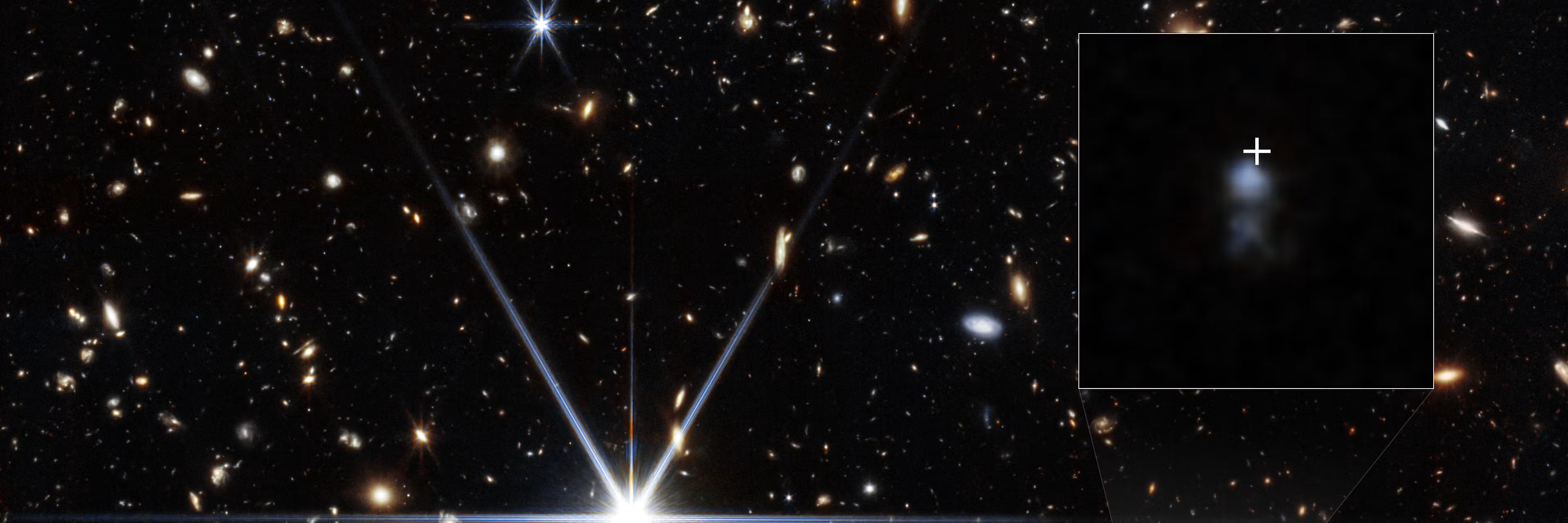
A recent discovery has pinpointed the origin of a fast radio burst (FRB) from an astonishing 10.6 billion years ago, providing unprecedented insight into the early universe.
Tracking Down the Burst
The burst, known as FRB 20240304B, was detected using the MeerKAT radio telescope in South Africa. This facility employs MeerTRAP, a system specifically designed to identify rapidly changing transient signals from space. The detection of FRB 20240304B emphasizes the effectiveness of MeerKAT in contributing to our understanding of cosmic events that once appeared elusive.
This particular FRB exhibited significant dispersion, a phenomenon caused by the signal traversing electrically charged matter throughout its journey to Earth. Such dispersion acts as a cosmic fingerprint, allowing scientists to deduce its immense distance. By assessing this dispersion, researchers traced it back to a small galaxy teeming with young stars. The distance not only illustrates the technological capabilities of today's observational tools but also highlights the vastness of space and time, reminding us just how old the universe truly is.
Unveiling the Faint Galaxy
Efforts to locate the host galaxy using ground-based telescopes like the Keck Telescopes initially yielded no results; the galaxy proved too faint for detection. Ground-based observations face inherent limitations from atmospheric interference and light pollution, both of which obscure our view of distant cosmic objects. However, the James Webb Space Telescope stepped in, revealing a small galaxy in close proximity to the FRB’s originating location. Webb's unique capabilities allow it to leverage infrared wavelengths to peer through cosmic dust, unveiling features unobservable to other telescopes.
Through spectral analysis, astronomers determined not just the galaxy's distance but also its characteristics. This was confirmed to be a galaxy existing 10.6 billion years ago, during a formative period in cosmic history. The significance of this discovery cannot be overstated; it's like looking back in time to when our own Milky Way was just beginning to emerge from the chaos of the early universe.
A Small but Significant Discovery
What sets this galaxy apart is its mass—around 10 million times that of our Sun—which represents a fraction of the Milky Way's mass. This young galaxy exhibits low metal content and is actively forming new stars, suggesting it differs from larger galaxies that typically host fast radio bursts. For many, this discovery might seem like another data point, but it’s indicative of a larger narrative about the universe; smaller, less massive galaxies may be the breeding grounds for understanding cosmic evolution.
Some theories propose that magnetars, a type of young and highly magnetized neutron star, may be responsible for generating these bursts. However, given the variety in FRB characteristics, it’s clear that multiple origins may be at play. This complexity highlights the scientific puzzle that FRBs represent — there could be more than one ingredient in the cosmic recipe responsible for these events.
A Cosmic Miscellany of Information
While the distance of the burst is remarkable, the true value lies in what its signal reveals. As it journeyed through space, the radio waves imprinted sensations of the magnetic fields and environmental changes they passed through, creating a wealth of information about the cosmos. Here’s the thing: each FRB carries with it a history of its path, acting like a time capsule that reveals insights into the conditions present in the universe billions of years ago.
For instance, the signal offers insights into electron distribution across the cosmic web and the complexities of magnetic fields. Measuring how the signal's orientation twisted allows scientists to gather data on these fields over billions of light years. This type of information could potentially inform us about the unsolved mysteries of dark matter and energy, which continue to puzzle astronomers and physicists alike. What this means for you, if you're working in this space, is that each new FRB could provide a piece of the cosmic puzzle.
Importance and Future Implications
This finding marks the earliest instance of fast radio bursts dating back to roughly 3 billion years post-Big Bang, a time when star and galaxy formation was particularly active. The timing fits nicely within a crucial era of cosmic evolution, shedding light on how galaxies like our own might have formed. By extending our grasp on these ancient events, we open new avenues for investigating the distribution of electrically charged matter in the universe over roughly 80% of its history.
Detecting these distant signals poses challenges, due to the faintness of both the FRBs and their host galaxies. Yet, the next steps involve identifying a larger sample of such bursts. Each additional burst serves as a kind of cosmic marker for understanding galactic evolution and the transformation of intergalactic space through time. We’re standing on the edge of a new frontier in astronomy — one where the universe's history is slowly being written in the signals we’ve only just begun to decode.
This article is republished from The Conversation under a Creative Commons license. Read the original article.
Lead image: NASA, ESA, CSA, STScI, Themiya Nanayakkara (USYD), Joseph DePasquale (STScI), CC BY


Discussion
Sign in to join the discussion.