NASA has revealed a captivating image from the Hubble Space Telescope showing a galaxy cluster that strikingly resembles a smiley face.
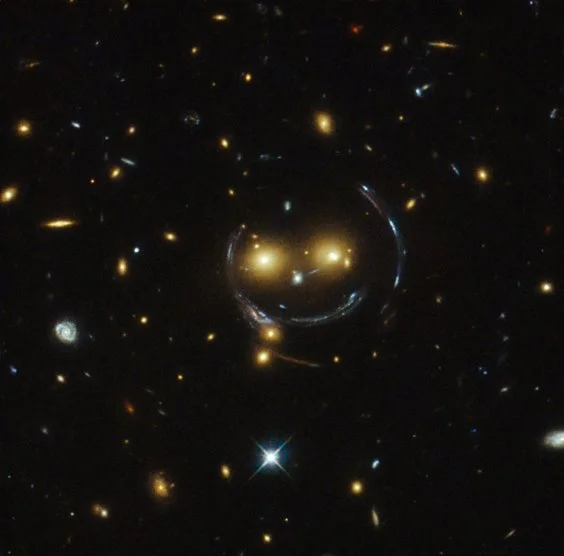
Humans are naturally inclined to recognize faces, even in abstract settings, and NASA scientists are no exception. Recently, they shared a fascinating image that captures a cosmic configuration reminiscent of a smiley face.
Understanding the Cosmic Smile
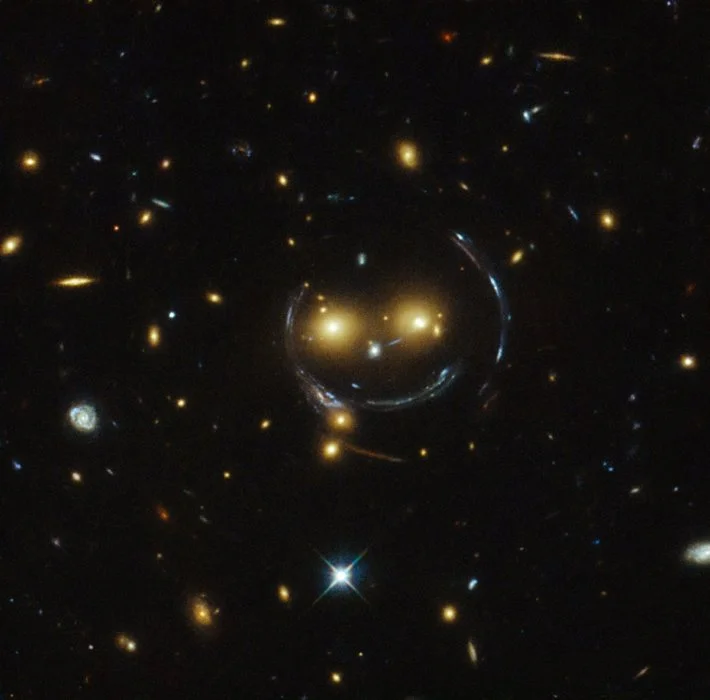
This striking image, taken by the Hubble Space Telescope back in 2015, features the galaxy cluster SDSS J1038+4849, located 4.5 billion light-years away in the Big Dipper constellation. The two yellow "eyes" are actually sizable galaxies, while the smile and face shape arise from gravitational lensing, a phenomenon that validates Einstein's theory of relativity.
Gravitational lensing is a fascinating effect caused by massive objects like galaxy clusters bending the light from objects behind them. When light from a distant galaxy passes near such a massive object, it bends and distorts, allowing astrophysicists to analyze the mass and structure of those galaxies from billions of light-years away. This process doesn’t just unveil new celestial objects; it also serves as a practical test for the fundamentals of physics, including our understanding of gravity.
Nobody actively sets out to draw a smiley face in the cosmos, but this phenomenon highlights how our brain's face-recognition mechanisms can play tricks—finding patterns even where none exist. It’s not just NASA; scientists across disciplines have experienced similar recognitions, leading to fascinating discussions on pareidolia, the human tendency to perceive familiar shapes in random stimuli.
Contextualizing Hubble’s Capabilities
The Hubble Space Telescope, operational since 1990, has been pivotal in transforming our understanding of the universe. Its high-resolution images and wide array of spectral data allow scientists to observe galaxies, nebulae, and other celestial phenomena in extraordinary detail. The telescope's work routinely acts as a bridge between abstract physics and public fascination, as it brings visions of the universe into a form we can all appreciate.
Hubble is especially prized for its ability to look back in time, revealing the early stages of star formation and galaxy evolution. In this case, the galaxy cluster SDSS J1038+4849 presents a unique opportunity to study not just the galaxies themselves, but also the effects of gravitational lensing and dark matter, elements that make up a considerable portion of the universe yet remain largely mysterious to astronomers.
What’s significant here is that the Hubble telescope isn't just eyepiece deep into the cosmos; it also captures moments that spark imagination and curiosity. This blend of hard science with visual storytelling serves as a reminder of why space exploration continues to captivate minds.
The Implications of Gravitational Lensing
Gravitational lensing offers more than just a pretty picture. It helps astronomers understand the distribution of dark matter, a component believed to make up about 27% of the universe's mass. Since dark matter doesn't emit light, its presence is inferred through its gravitational effects on visible matter. By studying lensing effects, researchers can infer how much dark matter exists in certain areas. This is a stellar example of how seemingly whimsical images can contribute to serious scientific analysis.
Moreover, this lensing effect symbolizes ongoing challenges in astrophysics. The complexity of understanding dark matter and dark energy represents one of the most pressing scientific puzzles today. While the image of a cosmic smile can delight, it also underscores the enduring mystery that still lingers around the universe's structure.
If you're working in this space or just a curious observer, you'll appreciate how such images aren't just about aesthetic appeal. They represent significant opportunities for education and awareness in scientific fields, engaging the public’s imagination and provoking questions about our universe.
Beyond Aesthetics: What's Next for Hubble?
The continuing discoveries made possible by Hubble raise questions about the future of space telescopes. With the James Webb Space Telescope now operational, scientists are keenly awaiting new insights in the realm of stellar observation. However, that doesn’t lessen Hubble’s impact; both telescopes are complementary, offering varying advantages in observing phenomena across different wavelengths.
While Hubble focuses predominantly on the optical spectrum, Webb's infrared capabilities will enable astronomers to chase further back in time to when the first stars formed. As we advance in observational technology, the blend of artistic views like the cosmic smile and data-driven research will grow even richer.
In short, the convergence of visual significance and underlying scientific inquiry implies that images like the one of SDSS J1038+4849 will keep inspiring future generations of astronomers and casual stargazers alike. This combination of discovery and recognition reminds us that science doesn't only reside in laboratories and observatories—sometimes, it manifests as a smile among the stars.
The post NASA Unveils Image of Galactic Phenomenon Resembling a Smiley Face appeared first on Nautilus.



Discussion
Sign in to join the discussion.