A gamma-ray burst spotted by Fermi produced an unusually bright afterglow, offering clues to how viewing angle can hide a jet’s true intensity.
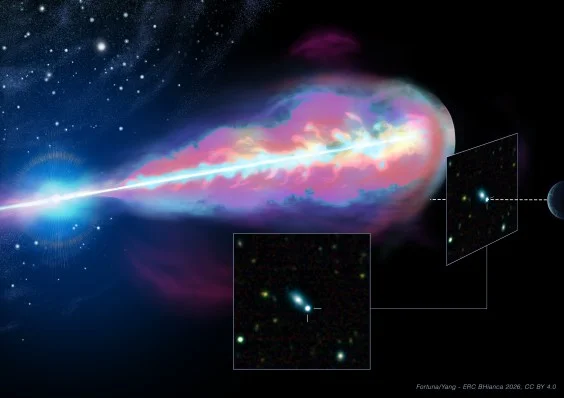
GRB 260310A looked fairly ordinary in gamma rays, but its afterglow told a different story. The glow grew bright enough to outshine its host galaxy, then flared again in X-rays weeks later. That mismatch matters because a burst’s first flash and its longer-lasting afterglow reveal different parts of the event. Here, the contrast suggests the burst’s apparent intensity depended heavily on the angle from which astronomers saw it. A familiar signal, followed by an unusually bright and persistent afterglow. That’s the puzzle.
A burst with an unusual afterglow
NASA’s Fermi Gamma Ray Space Telescope detected the initial flash on March 10, when a massive star collapsed about 2 billion light-years away. The burst’s gamma-ray emission was modest. Its afterglow, however, ranked among the brightest 1 percent of observed events in a newly published study. That ranking puts the event in an unusual group, but it doesn’t by itself explain why the afterglow stood out. The important question is how a comparatively unremarkable initial signal could be followed by such a conspicuous glow.
After a massive star collapses, it can launch narrow jets of gamma rays from its poles. As those jets travel through surrounding gas, they accelerate particles that release energy as radiation. The afterglow is this later emission, and it can change over time as the jet interacts with its surroundings. For GRB 260310A, the afterglow brightened over several hours until it surpassed the light from its galaxy, then faded. That changing brightness gave researchers a longer record of the event than the initial flash alone could provide.
Outshining a host galaxy is a striking comparison, but it also points to an observational challenge: the light astronomers measure comes from both the burst and its surroundings. When the afterglow becomes brighter than the galaxy, the transient event can dominate what would otherwise be a much fainter background. As it fades, the balance shifts again. In this case, the afterglow’s rise and decline offered clues about how the radiation was produced and how the burst was oriented toward observers.
Weeks later, the source brightened again in X-rays. The researchers suggest that this second rise may have come from light escaping the burst’s narrow central jet. The explanation is a proposal, not a direct view of the jet’s structure, and the source description doesn’t establish that every detail has been settled. Still, the late flare adds another feature a successful account has to explain. The researchers found the prolonged glow and later X-ray flare difficult to explain as a routine event.
Viewing angle changes the picture
The research team’s interpretation is that observers may have seen the burst from an angle that obscured its most intense region. “We see hundreds of GRBs every year, but the oddballs are the most informative ones,” study author Roberto Ricci said. He added that the team could explain individual features, but fitting them into one account was harder. That difficulty is revealing: a model can make sense of one stage of an event and still struggle to explain how the stages fit together.
Study author Yu-Han Yang said the event might have looked far more powerful to someone looking directly down the jet’s core. The team’s models suggest the explosion concentrated roughly a billion years of the Sun’s energy output into a pencil-thin beam. That estimate helps explain how a burst with modest gamma-ray emission could produce such a striking, long-lived afterglow. It also depends on the team’s interpretation of the viewing angle and the jet, rather than on an observer seeing the event from every direction.
Here’s the thing: the direction of observation can shape the story astronomers infer from a burst. A narrow jet viewed away from its core may not present the same apparent intensity as one viewed more directly. That doesn’t mean the event itself changes; it means the light reaching Earth can offer an incomplete view of its structure. For GRB 260310A, the modest gamma-ray flash and unusually bright afterglow are being read together as evidence that angle helped determine what observers detected.
This is more significant than it looks. Gamma-ray bursts are distant, brief events, so researchers can’t inspect their jets directly or replay the explosion from another vantage point. They have to piece together an explanation from the radiation that arrives at different times and wavelengths. A case with an unusual afterglow and a later X-ray rise can test whether a single picture accounts for several kinds of evidence. And yet, as Ricci’s comment suggests, fitting those pieces together remains harder than explaining any one feature in isolation.
More observations from more angles
Future telescopes with better performance and broader sky coverage could catch more gamma-ray bursts from a wider range of viewing angles. A larger set of detections could help researchers compare bursts that appear different from Earth and ask whether some of those differences reflect orientation. That comparison would build on the kind of reasoning used for GRB 260310A, where the afterglow’s behavior raised questions that the initial gamma-ray signal didn’t answer on its own.
More complete observations could also help connect what astronomers detect on Earth with the full structure and energy of the jets. The goal isn’t simply to identify unusually bright events; it’s to understand how the observed signal relates to the underlying explosion. If you’re working in this space, the practical lesson is that an ordinary-looking first flash may not tell the whole story. Follow-up observations can change the interpretation, especially when the source brightens again after it seemed to be fading.
That said, the outlook in the study is measured: better performance and wider sky coverage may help, but the source description doesn’t claim that future instruments will resolve every uncertainty. The researchers still have to explain how the event’s individual features fit into one account. More observations from more angles could make that task easier by giving them a broader basis for comparison. For now, GRB 260310A shows why the afterglow can matter as much as the initial burst when astronomers try to understand how massive stars die.



Discussion
Sign in to join the discussion.