ProBlak’s mural at Harvard’s Goel Center turns 11,000 square feet of exterior walls into a canvas shaped by community stories.
A campus landmark with a public audience
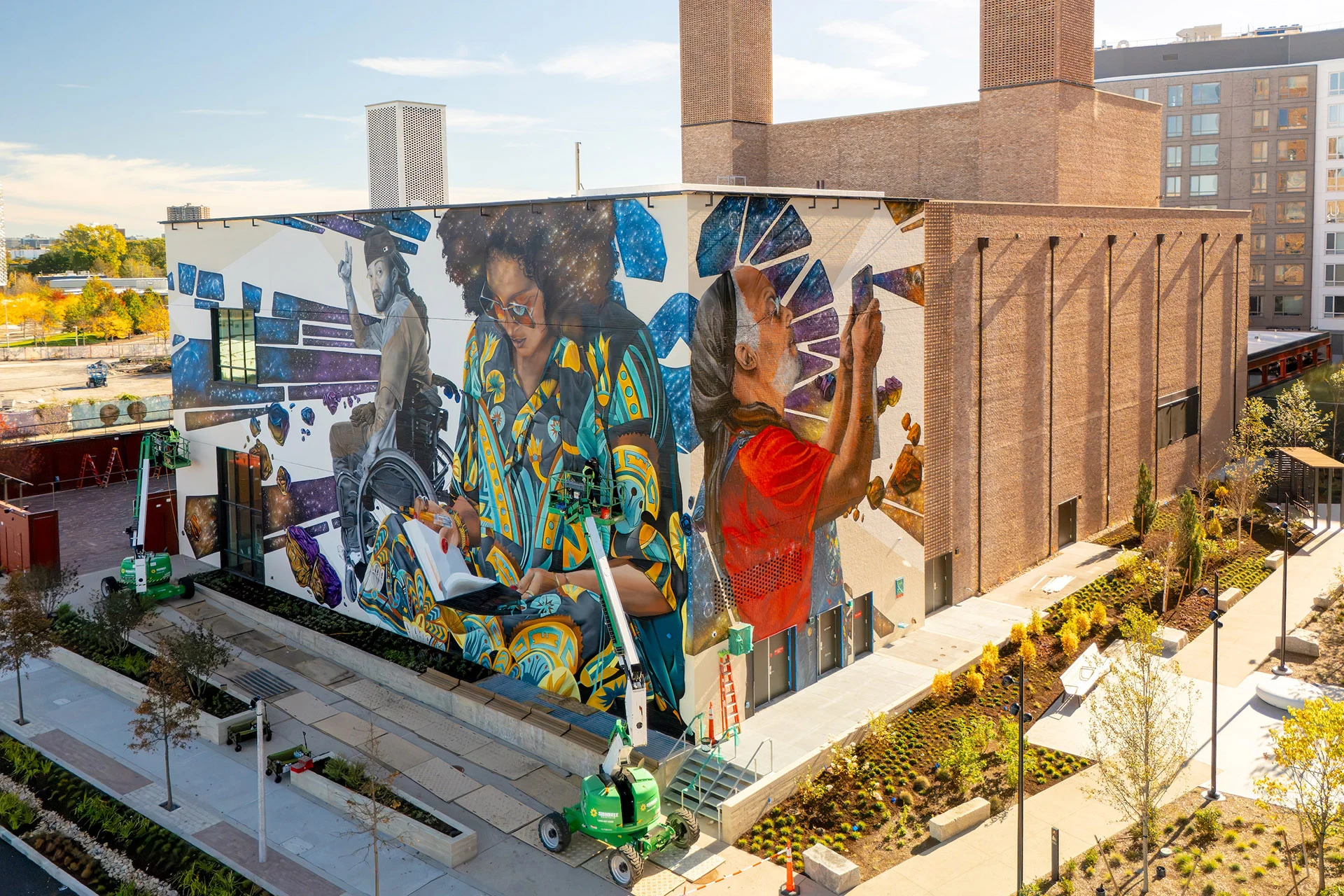
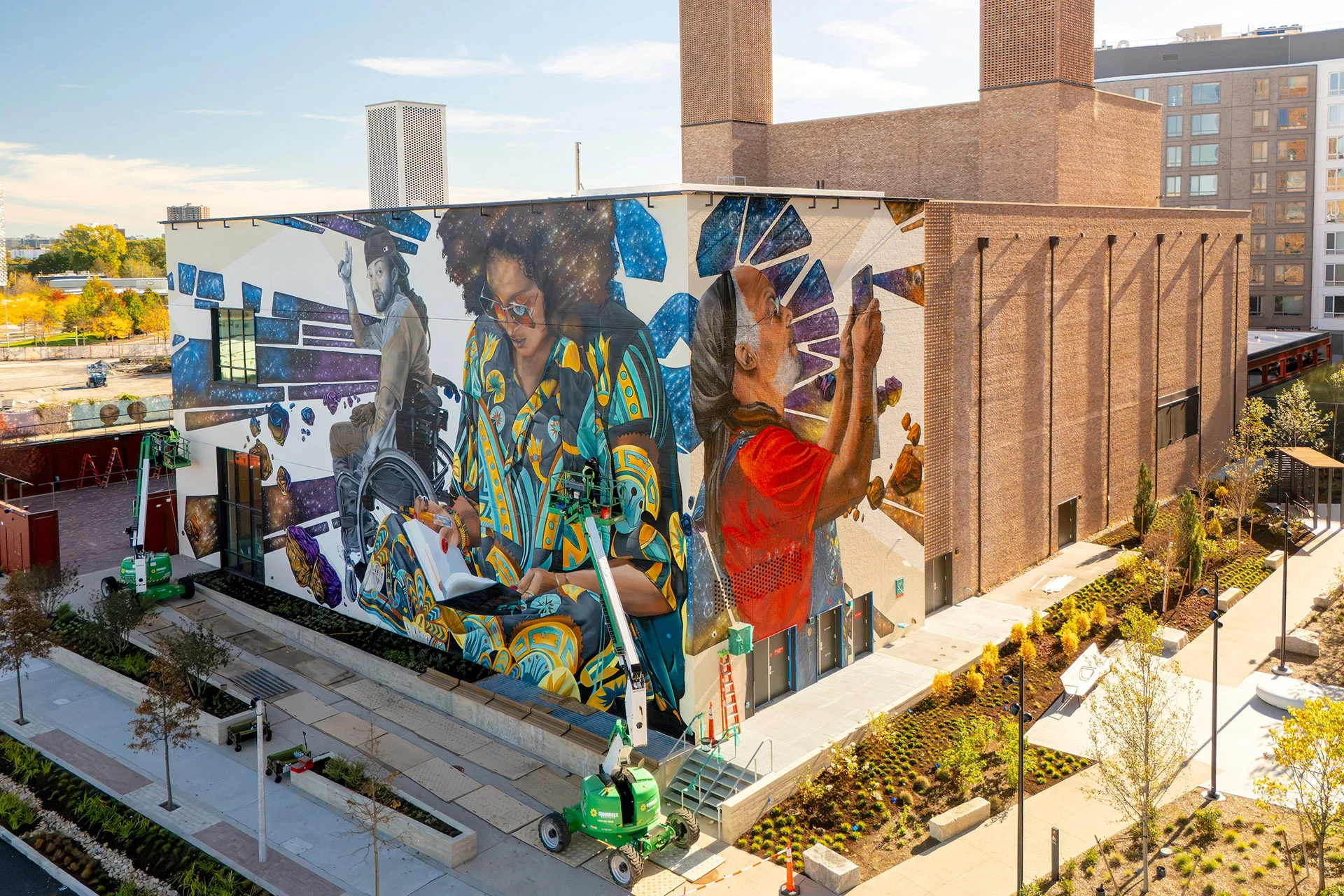
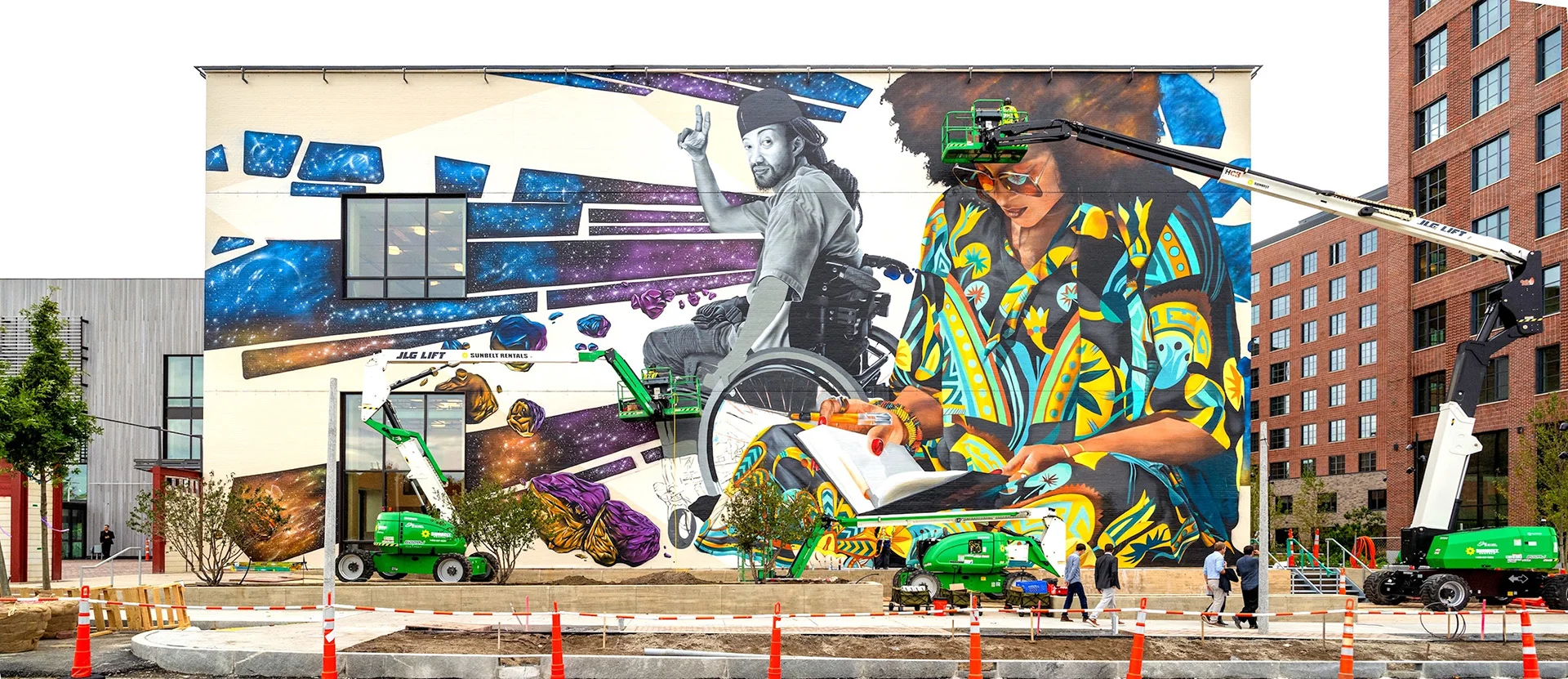
At 11,000 square feet, ProBlak’s new mural at Harvard’s David E. and Stacey L. Goel Center for Creativity & Performance gives the American Repertory Theater (A.R.T.) a public-facing canvas on a scale unmatched elsewhere on campus. The work, titled “Breathing Life Thru the Art of Storytelling,” stretches across several exterior walls at 175 North Harvard St. in Boston’s Allston neighborhood. Finishing touches are expected in the coming weeks, leaving the building’s exterior poised to become part of how people encounter the theater before they ever enter it.
G.Ortiz Photography
The mural measures 212 linear feet by 52 feet high, making it the largest public artwork on Harvard’s campus. Its scale also reflects A.R.T.’s aim to reach people beyond its theater audiences by using the building itself as a place for art. That’s a meaningful choice for an institution whose work is usually encountered inside a venue, on a schedule, and by people who have already decided to attend.
“From the outset of our work with our architects from Haworth Tompkins, we discussed how A.R.T. could use this building to extend its impact to the community beyond our traditional theatergoing audience,” said Diane Paulus, the Terrie and Bradley Bloom Artistic Director. She described the center as “a canvas — a two-dimensional stage” and pointed to Allston’s history as a hub for art and murals. The building’s walls make that ambition visible in the neighborhood, where the artwork can meet people on their ordinary routes through the area.
A mural shaped by community stories
A.R.T. commissioned Boston-based artist, organizer, and community builder Rob “ProBlak” Gibbs in July 2025. The mural continues his “Breathe Life” series, comprising works Nos. 9 and 10. The connection places the commission within an ongoing body of work, while its location gives this installment a particular relationship to the theater and the communities around it.
Before painting began, A.R.T. and ProBlak held community visioning workshops in September 2025 in Boston, Cambridge, and Malden. Artists whose work is exhibited in each community joined the sessions, where residents shared stories about the region’s past, present, and future. Those conversations helped shape the mural’s focus on creativity as a shared process grounded in listening, exchange, reflection, and collective possibility. The process matters because a public artwork can claim to represent a place without showing how local voices informed it; here, the workshops offer a stated link between consultation and the finished work.
“Art is typically categorized as two- or three-dimensional — for me, there is a fourth dimension: the shared story,” ProBlak said when the commission was announced. He added that a shared story can keep a mural or theatrical experience alive long after its creation. That idea shifts attention from the painted surface alone to the conversations and memories viewers bring to it. A mural doesn’t tell every viewer the same thing.

Building a public stage
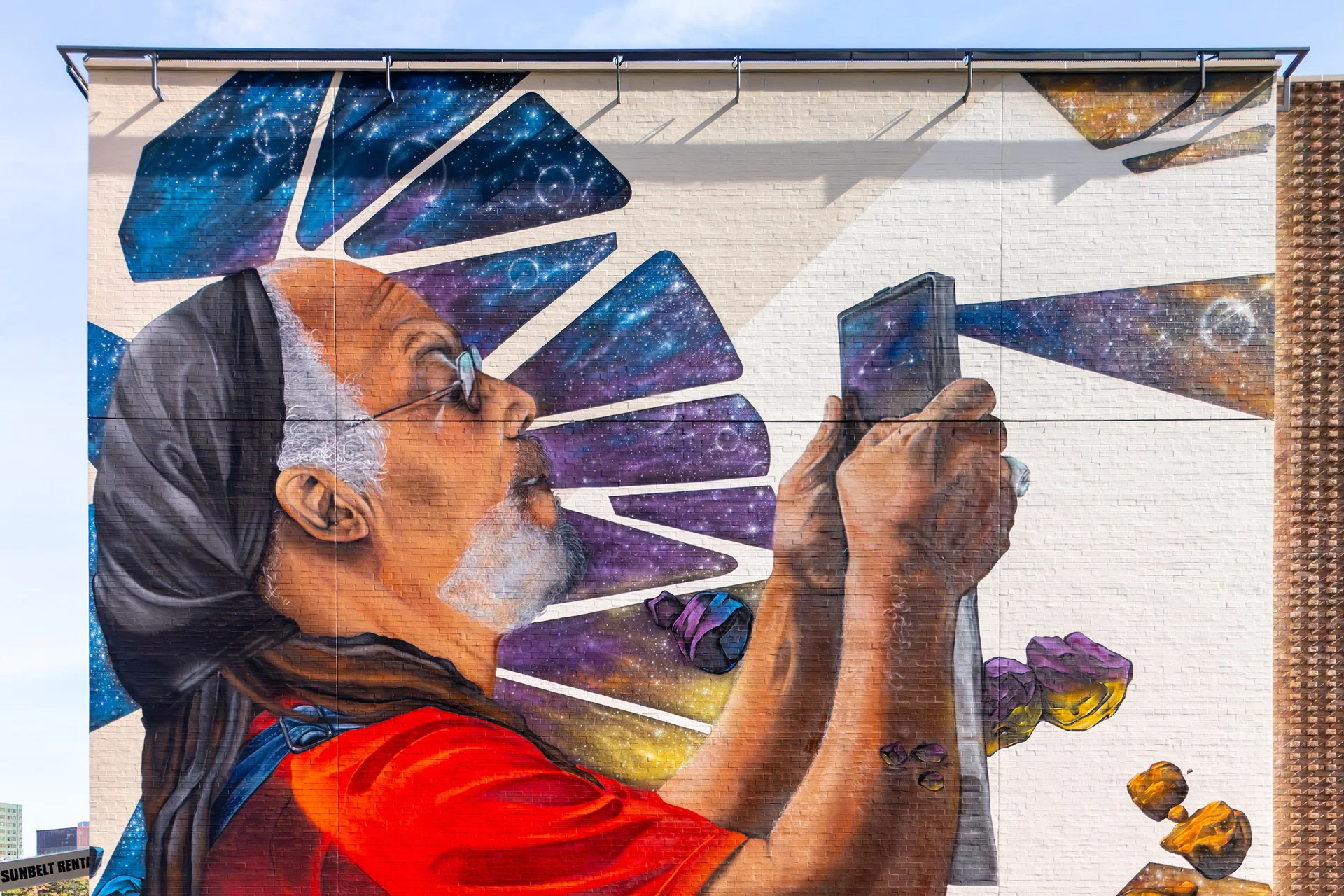
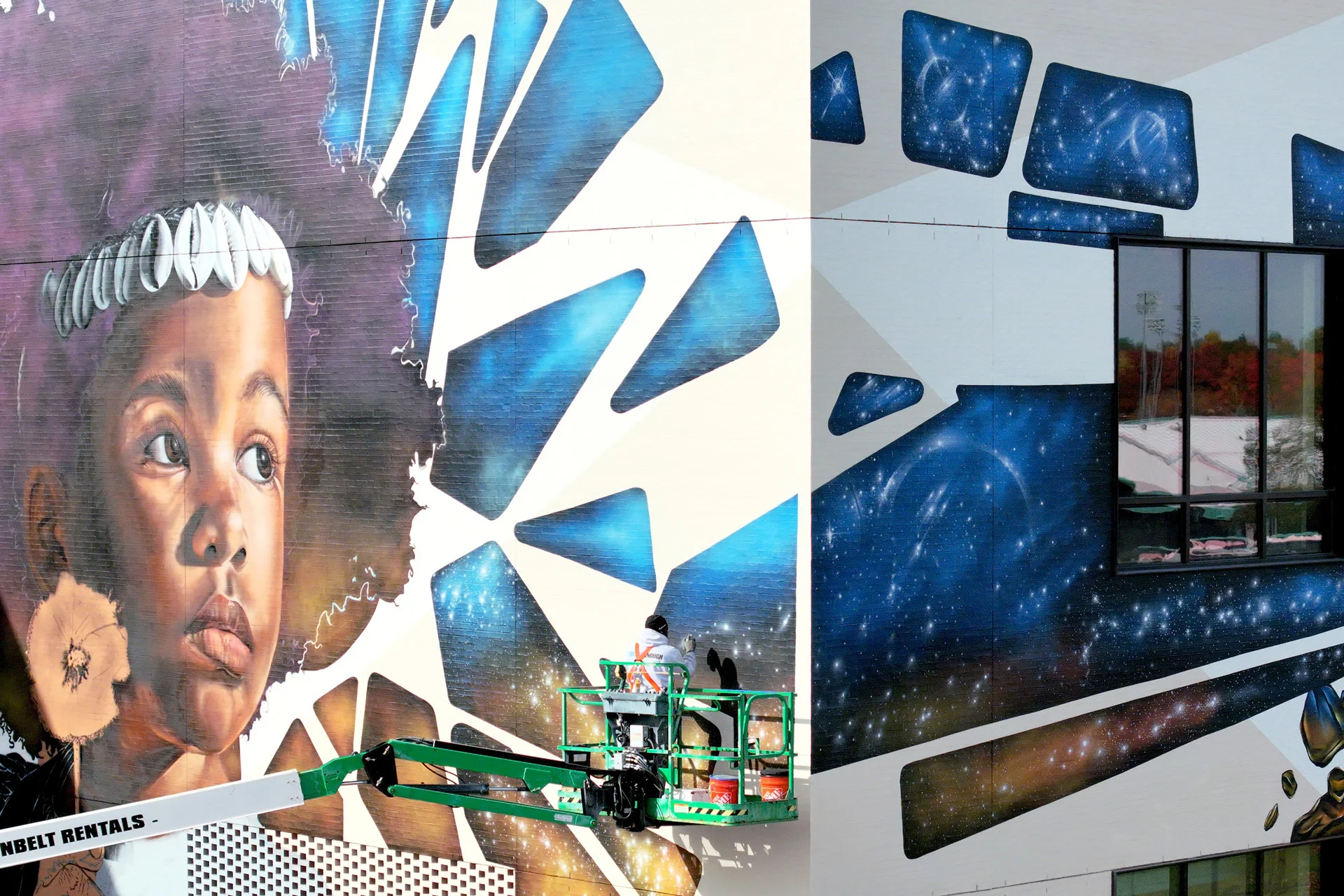
ProBlak and assistants Victor “Marka27” Quiñonez, Jeff Henriquez, and Lee Beard began painting the west-facing surface in August. The finished work invites viewers to think about how shared stories connect generations and change as they move from ideas into collective experiences. The scale makes that invitation hard to miss, though its meaning will depend on how people respond to it over time.
G.Ortiz Photography
HUPAD
Shawmut
For ProBlak, the project is a way to amplify other creators’ voices and emphasize common ground. “A mirror,” he said of the mural, which A.R.T. Associate Artistic Director Dayron J. Miles called a public stage for Boston’s stories of its history, present-day life, and hopes for the future. The mirror metaphor also leaves room for disagreement: people may recognize different parts of the city, or themselves, in a shared image.
What the building makes possible
This is more significant than it looks. A.R.T. is treating the center’s exterior as part of its public presence, extending the idea of performance into a space people can encounter without buying a ticket or knowing the theater’s program. If you’re working in this space, the useful question is whether that public invitation continues through the building’s activity and relationship with its neighbors, rather than stopping at the painted walls (and this is the part most people overlook).
That said, the commission’s community workshops provide a concrete starting point for that relationship: residents and local artists contributed stories before the painting began. The mural’s stated themes of listening and shared possibility set an expectation that the center can serve as more than a venue. Whether that expectation holds will become clearer as audiences begin using the building and the artwork becomes part of daily life in Allston.
The Goel Center’s public opening is scheduled for Monday, April 5. A.R.T. plans to welcome audiences in May for the building’s inaugural production, the world premiere of “Life on Mars,” featuring the music and lyrics of David Bowie and directed by Paulus. The mural and the production will introduce the center through two different forms of storytelling: one fixed to the exterior, the other staged for audiences inside.


Discussion
Sign in to join the discussion.