A faint young sun may have let Earth’s oceans form, while Venus stayed a steam world. The same stellar brightening will eventually threaten Earth’s habitability.
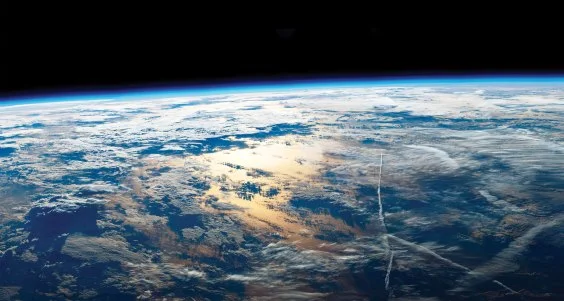
Earth’s oceans may owe their existence to a dimmer sun. Climate simulations suggest that the young sun’s weakness did more than pose the famous problem of how early Earth stayed warm: it may have kept the planet cool enough for steam to condense into rain and fill the oceans. Venus, closer to the sun and exposed to greater early heat, may never have reached that point.
Earth and Venus began with similar ingredients
In 1972, astronomers Carl Sagan and George Mullen described the Faint Young Sun paradox. Billions of years ago, the sun produced roughly 25 to 30 percent less energy than it does now. By conventional expectations, Earth should have frozen, yet geological evidence indicates that liquid water existed on its surface. Scientists have long sought to explain how the planet stayed warm enough.
Recent work shifts attention to a related question: how did Earth’s water become an ocean at all? Earth and Venus formed as neighbors from colliding rocky material and likely drew on similar water-bearing ingredients. Research on enstatite chondrites, meteorites whose isotopic composition resembles Earth’s, has strengthened the case that our planet acquired much of its water in the material from which it formed.
If that interpretation is right, early Venus also started wet. Its atmosphere today offers a clue to what happened next. Venus holds a high proportion of deuterium, a heavy form of hydrogen. That pattern is consistent with water molecules breaking apart, ordinary hydrogen escaping to space, and more of the heavier deuterium remaining behind. Venus may once have contained as much water as Earth.
The planets’ divergent histories may therefore hinge less on what they were made of than on the conditions after their formation. Giant impacts in the final stages of planet building released enormous heat and melted the surfaces of young worlds. Water at the surface turned to vapor, creating thick steam atmospheres. Whether that vapor could cool and fall as rain depended on the planets’ climates.
Rotation changes the cloud cover
A planet’s spin can determine where its clouds form and what those clouds do to its temperature. Earth rotates once every 24 hours today, but its early day may have lasted only four hours. The moon’s gravitational pull gradually slowed the planet. Venus, by contrast, rotates once every 243 Earth days. Its slow spin may reflect a combination of a suitably directed giant impact and powerful solar tides acting on its thick atmosphere.
On a slowly rotating planet, intense sunlight can drive a persistent cloud deck over the dayside. These bright clouds reflect incoming energy back into space. In a 2013 study, climate modelers Jun Yang, Nicolas Cowan and Dorian Abbot, then at the University of Chicago, showed how this cloud response could help a planet retain liquid water even when it orbits close to its star. A small rise in temperature can strengthen atmospheric convection, build thicker clouds and increase cooling.
That process changes estimates of the habitable zone: the range of orbits where surface conditions can support liquid water. Dayside clouds can move the zone’s inner edge inward by about one-third. In 2016, a study led by Michael Way at NASA’s Goddard Institute for Space Studies argued that Venus’s slow rotation might have produced such a cooling cloud deck, allowing the planet to remain habitable for billions of years.
But that scenario assumed Venus already had oceans. A 2021 study led by planetary astronomer Martin Turbet, now at the Institut Pierre-Simon Laplace in Paris, instead examined whether water could condense from Venus’s early steam atmosphere. The team found that the clouds would likely have collected on the nightside, where they trapped infrared heat and slowed the planet’s cooling. Those clouds would have acted less like a sunshade and more like an insulating layer, keeping the surface too hot for rain to reach it.
The team’s calculations put the sunlight threshold for ocean formation at about 95 percent of today’s intensity. Early Earth received roughly 70 to 75 percent of the sunlight it gets now, leaving room for its steam atmosphere to cool and rain out. Early Venus received about 135 percent of today’s solar intensity. Under those conditions, the planet could remain trapped in a hot, vapor-rich state. Had the young sun shone at its present strength, Earth might have struggled to form oceans too.
Water could form on Mars but fail to last
Mars faced the opposite problem. Its greater distance from the sun made it easier for water vapor to condense, and geological features point to liquid water on its early surface. The open question is how long that water persisted. A much thicker atmosphere may have kept it liquid for extended periods; alternatively, impacts may have supplied temporary bursts of heat that brought water to the surface.
Mars’s small size made long-term stability difficult. The planet cooled relatively quickly and lost its magnetic field, leaving its atmosphere more exposed to charged particles from the sun that could strip it away. The history of Martian water thus turns on more than the possibility of rainfall: a world also needs the conditions to preserve its atmosphere and surface water.
In a 2023 follow-up, Turbet and colleagues mapped a “water condensation zone” within the habitable zone: the region where a planet could form an ocean from its atmosphere and then keep it. The boundaries depend on the host star. Red dwarfs, which are smaller than the sun and common in the galaxy, are especially bright early in their lives, then change little in brightness. Planets around them may therefore face a difficult early climate, even if their current orbits fall within the habitable zone. For some promising targets, the central question may be whether oceans ever formed.
The sun’s gradual brightening sets a limit
The Faint Young Sun paradox also points toward Earth’s long-term future. Sun-like stars produce energy through fusion, combining hydrogen into helium. As fusion proceeds, the number of particles in the core falls. The resulting pressure change allows the core to compress and heat up, which raises the rate of fusion. The sun’s output increases slowly over time, on a scale far longer than human lifetimes.
As the sun brightens, the habitable zone shifts outward. Its inner boundary is now only slightly inside Earth’s orbit, and current estimates put Earth’s transition into the solar system’s too-hot region roughly a billion years from now.
Earth’s fast rotation limits the cooling help it can get from clouds. On a rapidly spinning planet, the Coriolis force breaks apart the stable dayside cloud cover that can form on slow rotators. A 2014 study by Yang and collaborators showed that a planet’s spin rate strongly affects the inner edge of its habitable zone. Earth’s cloud patterns may change as sunlight grows stronger, but climate models disagree about whether those changes could offset much warming.
The planet’s geological thermostat can buy time. The carbonate-silicate cycle draws carbon dioxide from the atmosphere and stores it in the seafloor over geological timescales. As the sun brightens, that process is expected to reduce atmospheric carbon dioxide. Eventually, however, levels may fall too low for photosynthesis, around a billion years from now. The thermostat would then lose its ability to maintain conditions for life as we know it.
After that threshold, more water would enter the atmosphere. Because water vapor traps heat, warming could drive further evaporation, raising atmospheric water content again and intensifying the greenhouse effect until the oceans evaporated. Earth’s habitability depends on a balance that has shifted with the sun’s brightness, planetary rotation and atmospheric feedbacks. The same faint sunlight that made ocean formation possible is part of a temporary window; Earth’s own cloud cover is unlikely to provide a lasting shield as that window closes.



Discussion
Sign in to join the discussion.