A massive star engulfed a smaller companion in Andromeda, giving astronomers an unusually complete view of common envelope evolution.
A merger caught across its lifetime
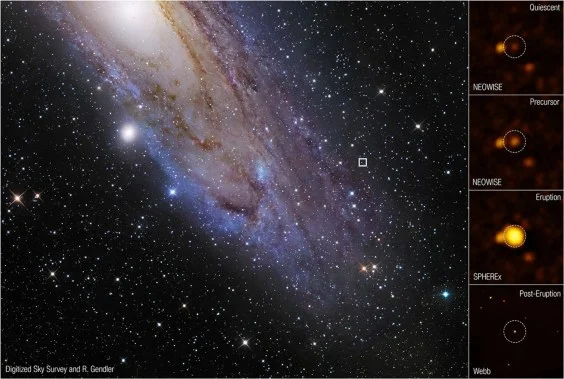
A seven-year stellar merger in the Andromeda galaxy has given astronomers an unusually detailed look at common envelope evolution, a phase in which two stars share a surrounding cloud of gas. Observations captured the system before, during and after the stars merged, offering a rare record of a process long understood mainly through theory. That sequence matters: a single bright outburst can reveal that a merger happened, but it usually leaves researchers with less evidence about how the stars reached that point.
The larger star had about seven times the Sun’s mass; its companion had roughly one-tenth of the Sun’s. As the smaller star’s outer gas came into contact with the supergiant, it lost orbital energy and spiraled inward. The encounter ended in an exceptionally bright eruption and left a single star, nicknamed Bao. The observations connect those stages in one system, giving astronomers a way to compare the physical picture of a shared envelope with what the stars actually did.
Located about 2.5 million light-years away, the system was studied with the James Webb Space Telescope and other observations. The merger’s full progression, from the companion catching on the supergiant’s outer layers to its engulfment, took seven years. Such events can take centuries to unfold, making the speed and timing of this one striking. A short timeline gives astronomers a rare chance to follow a stellar transition within the span of a modern observing effort, rather than infer its stages from separate examples.
Observations of the system began in 2023, and the results were published in Nature. “We thought it would take centuries for an outburst to happen, and then one day it erupted,” study author Nadia Blagorodnova said in a statement. “We were flabbergasted.” The surprise speaks to a basic challenge in studying rare events: predictions about how long a process takes can shape what astronomers expect to see, while an eruption that arrives on a much shorter schedule can expose gaps in that picture.
Why the shared envelope matters
Common envelope evolution gets its name from the shared gas around the two stars. The interaction can lead to a merger, as it did here, but not every system ends the same way. The stars may instead move toward other outcomes, including supernova explosions or black holes. That range of possible endings is one reason the process attracts attention: the interaction can affect what remains of the stars, not just how they look during the encounter.
In this case, the smaller companion’s inward spiral is central to the account. As it moved through the supergiant’s outer material, it lost orbital energy; the system’s eventual eruption marked a dramatic stage in that interaction. The available observations make the chain of events unusually tangible, though they don’t turn every detail of common envelope evolution into settled science. One well-observed merger can test ideas about the process, but it can’t establish that all systems with shared envelopes behave the same way.
This is more significant than it looks. Stellar mergers are difficult to study because the key stages are brief relative to the lives of stars, and the final bright event can draw attention away from the slower changes that precede it. Here, astronomers have a record spanning before, during and after the merger. (And this is the part most people overlook.) The value lies as much in that sequence as in the eruption itself.
What Bao can—and can’t—tell astronomers
Whether Bao was rejuvenated by material from its companion remains uncertain. The observations establish how this particular system evolved, but its aftermath still needs to be understood. The name gives the merger a memorable identity; it doesn’t resolve the harder question of what the merger changed inside the surviving star.
That uncertainty is useful to keep in view. A merger can leave astronomers with a clear account of the stars’ interaction while still raising questions about the remnant’s later life. Similar systems typically have to be examined through the evidence available at each stage, and researchers can’t assume that a visible eruption provides a complete account of what happened within the star. For Bao, the remaining question is whether the companion’s material altered the survivor in a lasting way.
For study author Kishalay De, the broader value lies in what systematic sky surveys can reveal: “These surveys are opening up completely new avenues to study dying stars and perhaps even discover new phenomena we haven’t seen before.” With a detailed merger record in hand, astronomers have a stronger basis for comparing other short-lived stellar eruptions as they appear. A single case won’t settle the wider theory, but it can help researchers recognize which observations are most useful when another event is caught in progress.
What systematic watching may change
The episode also shows why repeated observation matters. A survey that checks the sky over time can find changes that a one-time view would miss, while follow-up observations can help place a flare within a larger sequence. If you’re working in this space, the practical point is straightforward: timing can be as informative as brightness. An eruption’s context—what the system was doing before it, and what remained afterward—can shape how confidently researchers interpret it.
And yet, there’s no guarantee that future events will provide the same kind of record. The seven-year progression was unusually accessible, while other common envelope interactions may unfold over much longer spans or leave a different observational trail. This case offers a reference point, not a template for every merger. A useful one, though.
The next step is to compare this sequence with other stellar eruptions and test whether their observed stages fit the same account. That work may clarify which features are common to these interactions and which belong specifically to Bao’s history. For now, the result is both a rare observational achievement and a reminder that theoretical expectations can be revised when the sky moves faster than anticipated.
Lead Image: NASA/ESA/CSA/STScI/Viraj Karambelkar (Columbia)/Kishalay De (Columbia)


Discussion
Sign in to join the discussion.