The unique Arsia Mons Elongated Cloud reveals unusual atmospheric physics, demonstrating how ice can form without traditional condensation nuclei.
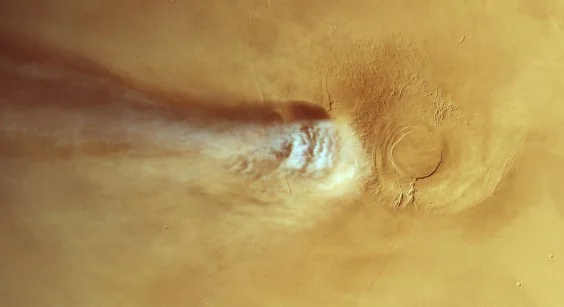
Standing at the base of Arsia Mons during the Martian spring or summer dusty season presents a breathtaking spectacle known as the Arsia Mons Elongated Cloud (AMEC). At dawn, this formidable cloud, flanked by the colossal volcano, manifests dramatically as air ascends its slopes.
The Phenomenon of the AMEC
The Arsia Mons Elongated Cloud (AMEC) isn't just another atmospheric phenomenon; it's a stunning example of the unique weather patterns seen on Mars. During the Martian spring and summer, warm air rises, creating a highly visual display. This isn't a simple puff of vapor, but rather, a vast cloud formation that stretches approximately 1,120 miles—about one and a half times the distance of California. When observed, it becomes apparent that this phenomenon forms due to a specific interplay of temperature and atmospheric conditions, which differ dramatically from those on Earth.
As warm air ascends, it meets extremely low levels of water vapor. The drop in temperature in these altitudes causes the vapor to freeze, resulting in a cloud formation. What’s particularly fascinating is that these clouds can swiftly dissipate as temperature rises with the sunlight. Within hours, conditions change, leading to the cloud’s reformation at dawn. This cyclical nature underscores the dynamic environment on Mars, distinguishing its meteorological activity from that of Earth.
Conditions Behind the AMEC
The AMEC's behavior can be attributed to a mix of Martian geography and atmospheric composition. It’s not just any old cloud; it forms under remarkably specific conditions that are a direct consequence of Arsia Mons’ massive stature and the thinness of Mars’ atmosphere. As researchers have reported, powerful winds—some reaching speeds of 373 miles per hour—help to push the cloud along, creating the long, trailing shapes that are visually striking and scientifically significant. But why does this happen on Mars and not on Earth?
Here’s the thing: while we can observe clouds forming on our planet due to various particles known as condensation nuclei—such as salt, pollen, or dust—the findings surrounding AMEC indicate a different process. This cloud appears to form ice particles without these familiar ingredients, providing a window into how distinct Martian conditions can lead to unexpected outcomes. At the heart of this mystery lies the phenomenon of homogeneous nucleation, which differs markedly from the processes we know and study on Earth.
Research and Observations from Mars Express
Ongoing research into the AMEC relies heavily on information gathered by the Mars Express orbiter, which has been studying the weather patterns on Mars since its launch in 2003. Despite being operational for two decades, its recent focus on the AMEC has been significant, providing valuable insights into this unique atmospheric occurrence. (And this is the part most people overlook.) Knowledge gained through such missions enhances our understanding of Martian climate and its geological processes, which ultimately informs future explorations and missions.
Recent studies have suggested that conditions on Mars are not merely harsh; they’re extraordinarily complex. The combination of Arsia Mons’ considerable height, the Martian atmosphere's sparseness, and extreme relative humidity levels create a breeding ground for phenomena like the AMEC. Researchers have referred to this discovery as “wholly unexpected,” suggesting that Mars’ atmosphere operates on principles that are just beginning to be understood. The unique dynamics of the AMEC challenge existing paradigms of cloud formation and lead to deeper questions about atmospheric science not just on Mars, but across other celestial bodies.
The Significance of Homogeneous Nucleation
Homogeneous nucleation, the process identified as central to the formation of the AMEC, stands out as a significant finding in the field of planetary atmospheres. This mechanism hasn't been extensively documented outside Earth, making its identification on Mars particularly noteworthy. It raises attention to the potential for atmospheric processes on other planets that might be governed by fundamentally different principles than those observed on our own.
The implications go beyond academic curiosity. Understanding Martian weather systems can impact everything from our technologies for future manned missions to the potential for colonization. If you're working in this space, grasping how Mars interacts meteorologically with its environment will be essential for planning any long-term human presence there. Additionally, this research could open up avenues for comparing Martian atmospheric dynamics to those found on exoplanets, enriching our exploration of the universe.
Future Outlook
The findings related to the AMEC challenge not just current scientific understanding but the very framework we use to study planets. There are still numerous questions left unanswered, which means there’s ample opportunity for further study. As missions continue to explore Mars and its myriad phenomena, new tools and technologies will likely emerge, offering deeper insights into its atmosphere.
As we progress, these insights will play an increasingly pivotal role in shaping our understanding of both Mars and potentially habitable environments elsewhere. While the cloud may seem like a curious oddity on the surface, its underlying principles reflect the complexity of the cosmos, urging scientists and space enthusiasts alike to pay closer attention to the mysteries of our neighboring planet.
Enjoying Nautilus? Subscribe to our free newsletter.
Lead Image: ESA/DLR/FU Berlin


Discussion
Sign in to join the discussion.