Recent images from Mars reveal coral-like rock formations, hinting at the planet's watery past and potential cyclical climate patterns.
Unexpected Geological Analogies
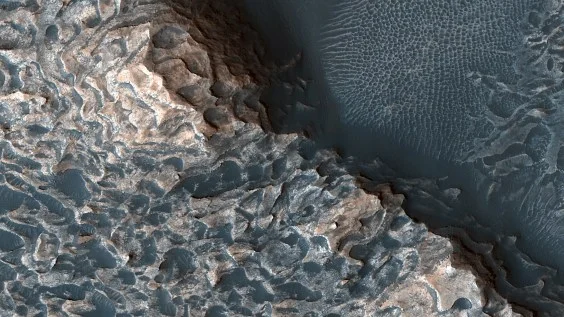
Mars, typically viewed as a barren wasteland, offers surprises that echo Earth’s geological features. Notably, the coral reef-like structures documented by the Mars Reconnaissance Orbiter indicate a dynamic planetary history, formed under conditions that suggest past cycles of dust storms and groundwater interaction. This challenges our long-held perception of Mars as a static, desolate environment.
For decades, scientists have been preoccupied with identifying the parameters that define habitability on other planets. The discovery of these coral reef-like formations provides an intriguing avenue for exploration. While it might seem counterintuitive to find such structures on a planet like Mars, they represent a unique interplay between geological processes and the planet's environmental conditions. Such findings underscore the notion that if we look closely enough, Mars might not be as lifeless as we previously thought.
Arabia Terra: Mars’ Multifaceted Mystery
Currently lifeless, the Arabia Terra region showcases a variety of craters and canyons, which have been shaped over billions of years by erosive forces. Spanning approximately 2,800 miles, it mirrors the extent of the continental United States. Most people think of Mars as uniform and empty, but regions like Arabia Terra reveal the complexity lying beneath the surface. You’ve got ancient riverbeds, vast plains, and impressive mountain ranges, all sculpted by time.
This geological diversity gives researchers a wealth of material to analyze. The varying features of Arabia Terra bear evidence of past hydrological activity. It's believed that ancient water flows helped shape the canyon walls and formed the craters that dot the surface. Two contrasting elements, erosion and preservation, come into play here, revealing a record of planetary history that parallels some of Earth's most significant geological characteristics.
HiRISE Imaging: Unlocking Colorful Narratives
The vibrant hues captured in these formations can be attributed to the capabilities of the HiRISE (High Resolution Imaging Science Experiment) camera on the orbiter. With its large mirror, this imaging tool captures color across three bands: near-infrared, red, and blue-green. While true coloring would reveal a reddish-brown hue from a spacecraft's vantage point, special processing unveils the darker and bluer tones of the underlying volcanic basalt, which is heavy in iron and magnesium. The lighter areas consist of finer materials like salt and clay, revealing the complex interactions with wind that shape the jagged rock formations we observe.
This layering of colors doesn’t just make for pretty pictures; it provides insights into the planet’s geological history that scientists can analyze to understand its past landscape. The interactions between volcanic activity and wind-driven erosion suggest that Mars went through significant climatic changes over millions of years. Each color tells a story, offering clues to the environmental conditions that once existed on the Martian surface.
Geological Clues and Future Missions
Researchers are actively studying these rock layers to better understand Mars' atmospheric evolution and historical climate shifts. The sedimentary stacks provide clues that water likely played a significant role in the planet's geological transformation over time. If you're working in this space, you know how valuable these insights can be for piecing together Mars' history. They could also inform discussions about future human habitation on the planet.
Insights drawn from remote observation are a mere starting point. A future mission to deploy a rover in Arabia Terra could yield substantial revelations about the mineralogical composition and formation processes of these fascinating rock layers. Such exploration could bridge the gap between current knowledge and the rich history encoded in Martian geology. Collecting samples and conducting in-situ analysis will offer clarity that distant observation cannot achieve.
Implications and Future Outlook
The exploration of Mars through missions like those aiming for Arabia Terra raises interesting questions. What new technologies must we develop to ensure safe landing and sample return? What can we learn about Earth by better understanding our neighboring planet? Each mission opens doors to new questions that fuel both scientific curiosity and public interest.
And this is the part most people overlook: the potential for collaboration between planetary scientists and astrobiologists could yield groundbreaking initiatives. As we continue to learn about the features and composition of Mars, our understanding of life itself could expand—shifting from simply investigating if life existed to asking under what conditions it could thrive elsewhere.
The next decade will be pivotal in Martian exploration. As we launch more missions, the integration of robotic and possibly human exploration will offer insights into not only Mars' past but could inform future technologies and our approach to planetary colonization. The stakes, both scientifically and economically, have never been higher.
If you find insights like this captivating, consider subscribing to the free Nautilus newsletter.
Lead Image: NASA/JPL-Caltech/UArizona


Discussion
Sign in to join the discussion.