The James Webb Space Telescope has captured a high-resolution image of IC 348, unveiling elusive brown dwarfs and new insights into star formation.
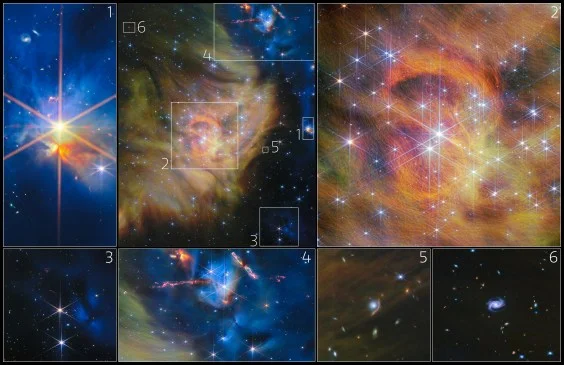
The James Webb Space Telescope (JWST) recently delivered one of its most striking images to date, revealing a vibrant vista of space dust and star formations that resembles glowing embers. Spanning an incredible 30,866 x 38,204 pixels, the photograph encompasses roughly 1.8 billion pixels, depicting a segment of the universe nearly five light-years wide.
IC 348: A Star Nursery Revealed
The focus of this image can be pinpointed in the region designated IC 348, located about 1,000 light-years from Earth within the Perseus constellation. Known as an active star nursery, this area is populated with several young stars, portrayed as bright blue dots in the JWST's capture, exhibiting light "spokes"—an optical phenomenon resulting from the telescope’s imaging system. Star nurseries like IC 348 are fundamental to understanding the lifecycle of stars, providing insights into how stars form, evolve, and ultimately die. The JWST is particularly well-suited for this type of observation, as its advanced instruments allow for unparalleled clarity in capturing these nascent astronomical structures.
The Quest for Brown Dwarfs
The primary goal of this observation is to identify brown dwarfs—celestial objects that fail to achieve the sustaining temperature necessary for hydrogen fusion. Unlike stars, which shine brightly due to ongoing nuclear reactions, brown dwarfs exist in a murky territory between stars and planets, often described as failed stars. JWST's observations have pinpointed brown dwarfs with masses equivalent to two Jupiters, representing the smallest such entities documented to date, notably lighter than previous theoretical estimates, which suggest they comprise less than 0.2 percent of the sun's mass. This new measurement challenges conventional models of star formation, as it implies that our understanding of the mass distribution among celestial objects may be limited or flawed.
The Near-Infrared Camera (NIRCam) on the JWST was instrumental in capturing these low-energy signals from brown dwarfs, overcoming the challenge of their cool and dim nature compared to nearby stars. While these faint objects are nearly invisible at lower resolutions, the high-detail image offers a chance for trained observers to spot them accurately. This aspect is particularly critical; astronomers depend heavily on advanced technology to unlock secrets of the universe that would remain hidden otherwise. In a typical observational context, identifying such faint objects is like trying to spot a candle flickering at a great distance while the sun is shining in full force.
Implications for Stellar and Planetary Formation
These new findings could prompt a reevaluation of the processes governing stellar and planetary formation. The data further complicates the boundary separating stars and planets, as evidenced by one particularly light brown dwarf showing signs of a disk formation around it. Traditionally, disks are thought to be associated with young stars in the process of planet formation. If brown dwarfs are forming surrounding disks, it raises questions about how planet formation occurs in this lower-mass regime. This paradigm shift could inspire new theories about how our solar system might have formed, and what other systems might look like.
Adding further intrigue to the image, the top right corner showcases young protostars accumulating matter, occasionally expelling jets of gas that outshine even the stars themselves. Known as Herbig-Haro objects, these jets manifest as bright streaks of color against the backdrop of the star-forming region. These phenomena are exciting not simply for their aesthetic appeal; they also reveal critical information about the physical processes at play during star and planet formation. As jets of material are expelled, they can carry away excess angular momentum, allowing the surrounding material to coalesce and form new celestial bodies. For a closer examination, one can explore this link.
The Future of Cosmic Exploration
Through this extraordinary image, the JWST provides an unparalleled view into the cosmos, revealing the intricate behaviors and formations of celestial entities that shape our universe. The implications of these findings extend beyond this single observation, potentially impacting how astronomers approach their work for decades to come. For instance, the techniques developed and data gathered through JWST’s mission could influence the design and scope of future telescopes and observatories. If you're working in this space, the changes underway now could very well shape the next generation of astronomical discovery, forcing researchers to confront outdated models and rethink their understanding of what exists in the depths of space.
The JWST is not just about capturing pretty pictures; each image tells a story about the universe’s complex intricacies. And this is the part most people overlook. The excitement surrounding these findings can lead to discussions not just about technology but about the nature of reality itself, what lies beyond our Earth, and what remains hidden, yet to be discovered in the expansive universe.
Lead Image: NASA, ESA, CSA, Kevin Luhman (PSU), Catarina Alves de Oliveira (ESA), Mahdi Zamani (ESA/Webb)


Discussion
Sign in to join the discussion.