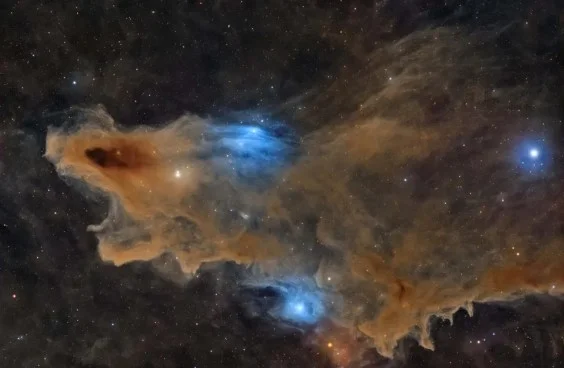
Ali Alobaidly's first-prize-winning photograph of the "shark" nebula reveals extraordinary interstellar detail, highlighting new star formation.
The Shark Nebula: A New Stellar Discovery
The recently unveiled "shark" nebula, officially known as Lynds Dark Nebula 1235, spans an impressive 15 light-years from its head to tail—a distance similar to that between the Sun and Proxima Centauri, our nearest stellar neighbor. This remarkable nebula has drawn public fascination not just for its size but also for its striking visual resemblance to a predator of the deep. Such astounding features underscore the universe's whimsy, often resembling forms and figures we're familiar with on Earth. This is more significant than it looks.
History and Recognition
This striking nebula was first identified over fifty years ago, yet it has recently gained renewed attention following Ali Alobaidly's award-winning photograph. That image clinched top honors at the Royal Observatory Greenwich’s ZWO Astronomy Photographer of the Year competition. Judges hailed the photograph as “perfectly rendered” and a testament to modern astrophotography techniques—a recognition that highlights not just the artistic beauty of the shot but also the technical prowess involved in capturing such distant cosmic wonders.
The resurgence in interest surrounding Lynds Dark Nebula 1235 isn’t just about aesthetics. It reflects an ongoing trend where amateur and professional astronomers alike are pushing the boundaries of imaging technology. Through enhanced sensors, computational techniques, and increasingly accessible high-quality equipment, the standard for astrophotography has soared. As a result, celestial entities that were once mere specks in the vast universe can now be rendered with breathtaking clarity.
Technical Achievements in Astrophotography
“The fine nebulosity captured is exquisite,” remarked Steve Marsh, art editor for BBC Sky at Night Magazine. His praise highlights a vital aspect of space photography: capturing the essence of a nebula relies on both visual quality and detail. The photograph allows viewers to zoom in on intricate features without sacrificing clarity—a feat that speaks volumes about Alobaidly's craftsmanship and the capabilities of modern equipment.
Achieving such an image is no small task. Alobaidly transported over 330 pounds of photography equipment into the Al Salmy Desert of Kuwait. He dedicated two starry nights in August to capturing the nebula through two paired lens telescopes. Each telescope, fitted with a monochrome camera, cycled through red, green, and blue filters, collecting data necessary for a comprehensive view. This meticulous approach, resulting in a combined exposure time exceeding 28 hours, showcases the dedication and patience required in astrophotography.
The Central Mystery of the Shark Nebula
After capturing such intricate data, the image underwent careful processing to enhance details and minimize noise, resulting in a stunning visual of the nebula located about 650 light-years away in the constellation Cepheus. The dark silhouette of the shark nebula starkly contrasts the surrounding stars, created by interstellar dust obscuring distant light. Such dust clouds are fundamental to understanding how stars and planets form in complex environments.
This region is believed to be a site of stellar formation, with three bright blue young stars illuminating the surrounding dust. The luminosity creates a striking visual juxtaposition that draws the viewer's eye. Notably, the dark patch representing the shark’s “eye”—where dense dust blocks light from beyond—contributes to the anthropomorphic allure of the nebula. Alobaidly's depiction captures the cosmic entity drifting silently through the cosmos, adorned by the glow of nearby reflection nebulae.
Astrophotography: Artistic and Scientific Implications
Alobaidly commented eloquently on his work: “Unlike its oceanic cousins, the Shark Nebula doesn’t bite, but it does photobomb astrophotographers with a molecular cloud big enough to make Earth look like a speck of plankton.” This whimsical observation highlights an essential truth in the field of astrophotography: the merging of art and science. Capturing such stunning images provides not just aesthetic pleasure but also valuable data for researchers. Researchers can use these visuals to better understand interstellar clouds and star formation.
And here's the thing: the allure of cosmic formations resembling familiar shapes adds a layer of drama to these astronomical phenomena. Just like spotting clouds forming recognizable figures, such imagery fosters curiosity and connection to the cosmos. For many stargazers and photography enthusiasts, these remarkable formations fuel interest in science—potentially inspiring the next generation of astronomers and astrophysicists.
Expectations and Future Pursuits
If you’re working in this space, this new recognition of the Shark Nebula also raises expectations regarding what can be captured in astrophotography. As technology continues to improve, and as more enthusiasts join the ranks of serious skywatchers, the accessibility of high-quality images of celestial phenomena will only increase. Expect to see more incredible captures that challenge our perceptions of space and time.
In summary, the stunning image of the shark nebula serves as both an artistic achievement and a scientific milestone. While such cosmic observations offer glimpses into the past and present of the universe, they also inspire awe and wonder. As photographers push boundaries and scientists seek answers, phenomena like Lynds Dark Nebula 1235 will undoubtedly continue to captivate our imaginations.


Discussion
Sign in to join the discussion.