A 32-hour binary system pairs a pulsing white dwarf with a Sun-like star, widening the search for long-period radio transients.
A repeating signal with a limited window
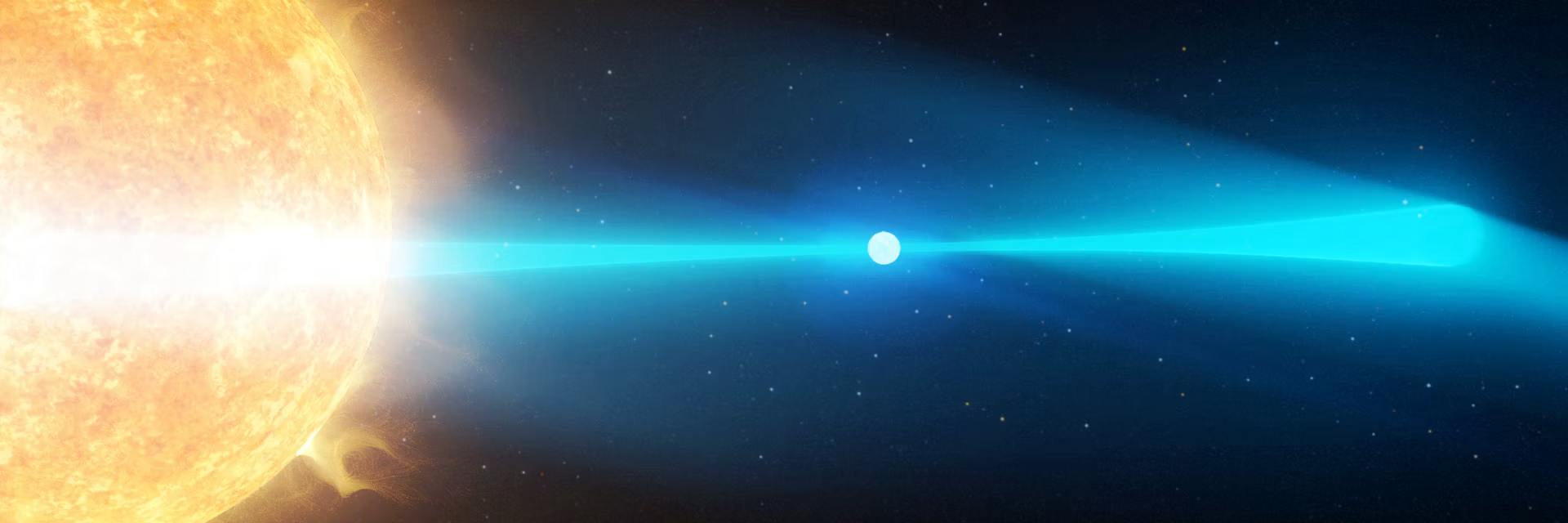
A radio source that flashes every 7.9 minutes has turned up in an unexpected place: a binary system containing a Sun-like star and, researchers believe, a white dwarf. The discovery suggests long-period radio transients may form in more kinds of stellar systems than astronomers had identified so far. That broadens the puzzle: these signals may share a repeating behavior while coming from systems with different companions and histories.
Long-period radio transients produce bright bursts at intervals ranging from minutes to hours. Since the first examples were found in 2022, several have been linked to binary systems containing a white dwarf and a faint red dwarf. A leading early idea—that the signals came from neutron stars rotating unusually slowly—ran into a problem: such slow rotation should not produce the radio emission observed. The tension between the proposed source and the observed bursts is why each newly characterized system matters; it can rule out some explanations while leaving others open.
In late 2024, a team searching with the Murchison Widefield Array in Western Australia found a new source using a method developed by PhD student Csanád Horváth. Its bursts arrived with striking regularity, every 7.9 minutes, then vanished. Weeks of observations seemed to offer no answer until the researchers compared detections with the periods when the signal was absent. The silence became evidence in its own right: a source that disappears on a schedule may be shaped by the geometry of its orbit, not simply switching off at random.
The bursts appeared during a roughly six-hour stretch, followed by about 26 hours of silence. That schedule points to a binary orbit lasting around 32 hours: the radio emission is detectable only when the system’s orientation brings it into view. The inference depends on treating the repeating windows as part of one orbital cycle. It offers a practical lesson for transient astronomy: observing when a signal is missing can constrain a system just as much as catching its brightest emission.
The Murchison Widefield Array identified the radio source. Observations with South Africa’s MeerKAT telescope then narrowed its position to a small patch of sky containing one faint star. Spectral measurements from the Keck telescope in Hawaiʻi showed that the visible star is a G-type star, close to the Sun in mass and temperature—not the small, cool red dwarf found in previously identified systems. Each instrument contributed a different piece: detection, location, then a clue to the companion star’s identity.
The unseen companion is too light to be a neutron star
The team inferred the companion’s mass from the motion of the binary. As the pulsing object travels around its orbit, the distance its radio waves must cover changes, shifting pulse arrival times by as much as four seconds. Those timing variations reveal the orbit’s scale. In systems like this, the pulses act as a clock: changes in their arrival times track the motion of the emitter, even though the companion itself can’t be seen directly.
The Sun-like star’s spectrum also shows how much it moves in response to its companion’s gravity. Its small wobble indicates that the visible star is much heavier than the object producing the pulses. Combining the orbital size, the 32-hour period and the spectral measurements puts the pulsing companion at about two-thirds the Sun’s mass—too little for a neutron star. The conclusion rests on several linked measurements, rather than on the radio signal alone.
The researchers’ interpretation is that it’s a white dwarf pulsar, and the first one identified orbiting a Sun-like star. The evidence makes this system a distinct addition to the known population of long-period radio transients. That identification is a reasoned interpretation of the system’s mass and behavior, not a direct image of the compact companion. Still, this is more significant than it looks: the visible star changes the range of binary environments astronomers have to consider.
How the binary may have formed
The proposed history of the pair begins with the star that became the white dwarf. As it expanded into a giant, it may have engulfed its companion. The companion would then have spiralled inward, tightening the orbit before the giant shed its outer layers. That sequence could explain how two stars ended up in a relatively close binary, though the account remains a possible reconstruction rather than an observed record of the system’s past.
Here’s the thing: a system’s present orbit can preserve clues to a complicated earlier interaction, but it doesn’t settle every detail of that history. In this case, the measured period and the likely white dwarf companion are consistent with the proposed path. They don’t, by themselves, show exactly how the stars exchanged material or how the radio emission is generated. A useful explanation, then. Not the final word.
What wider surveys could reveal
Such binaries may be hard to spot with ordinary light: a bright, Sun-like star can outshine its faint white dwarf companion. Radio pulses offer another way to find them, potentially exposing systems that optical and X-ray observations overlook. (And this is the part most people overlook.) A radio survey can flag a compact object through its changing signal even when its companion dominates the visible light, giving astronomers a route into systems that might otherwise look like ordinary stars.
Some white dwarf binaries are considered possible precursors to Type Ia supernovae, whose predictable brightness makes them useful for measuring cosmic distances. That broader connection gives the discovery extra context, but it doesn’t establish that this particular binary will produce a supernova. The system’s immediate value is as a new example that can help researchers compare how white dwarfs behave across different kinds of stellar pairings.
More discoveries could show whether white dwarfs that emit long-period pulses commonly orbit stars like the Sun. The SKA Observatory and other next-generation radio facilities are expected to expand the search, giving astronomers a new way to trace how stars form, interact and end their lives. If you’re working in this space, the key question is whether this source marks a rare exception or points to a wider class that earlier searches missed. Answering that will require more systems and careful comparisons of their signals, orbits and companions.


Discussion
Sign in to join the discussion.