Voyager 1’s 1980 Saturn flyby revealed the planet’s rings and moons in striking detail, including Titan’s hazy atmosphere and Dione’s icy terrain.
A flyby that changed Saturn’s appearance
Voyager 1’s Saturn flyby turned a distant, familiar-looking planet into a complex system of rings, moons and atmospheric worlds. The spacecraft captured the images in 1980, a year after Pioneer 11’s first close look at Saturn, and before Voyager continued toward the outer solar system. The change wasn’t simply a matter of sharper pictures: the views let scientists examine the planet and its surroundings as connected parts of one system.
Saturn’s rings can look like a smooth, flat band from far away. Voyager’s images instead showed structure, including a distinct division within the rings, while views of moons against the planet gave the scene depth and scale. A brief flyby can’t answer every question about a distant world, but it can reveal which questions deserve closer attention.
From Pioneer 11 to Voyager 1
Pioneer 11 launched in 1973 and passed Saturn in 1979. It mapped the planet’s magnetosphere, discovered two moons and photographed Saturn alongside its largest moon, Titan. That first encounter established a closer view of the system; Voyager 1 arrived a year later with images that showed the planet and several moons in greater detail during the spacecraft’s approach.
The sequence matters. Pioneer’s work gave scientists an initial look at Saturn’s environment, while Voyager added visual detail that could help place individual features in context. The missions weren’t interchangeable: each encounter built on what the earlier one had made visible. For a flyby mission, every image also has a practical limit—the spacecraft is moving on, so observations are gathered over a short window.
Voyager 1 photographed Saturn with Tethys, Enceladus and Mimas visible in the same frame. Another view picked out the Cassini Division, the gap between Saturn’s A and B rings, as well as the shadow cast by Tethys across the planet. Those details do more than make the pictures striking: they show how a moon and a ring system can be understood through their positions and interactions in the same view.
The Cassini Division is especially legible because it gives the eye a clear break between the rings. A shadow crossing the planet offers a different kind of evidence, linking the moon’s position to a visible mark on Saturn’s atmosphere. The photographs are snapshots, but they preserve relationships that a description alone would make harder to picture.
Titan and Dione in close view
Titan’s atmosphere emerged as a major subject of the flyby. Voyager detected a thick atmosphere and photographed the moon through its haze. An artificially colored image shows cloud cover darkening the region over Titan’s north pole; another emphasizes the layers of haze surrounding the moon. The images make the atmosphere itself the subject, even as it obscures the surface beneath it.
That’s a useful reminder about what a planetary photograph can and can’t show. A hazy moon may conceal surface details, yet the haze carries information about the world above that surface. For a spacecraft making a fast pass, observing that boundary is part of understanding the body, not a failure to see it clearly. And this is the part most people overlook: an obscured view can still be a revealing one.
Voyager also brought Dione’s cratered surface into view. Its bright, streaked “wispy terrain” was once thought to be ice deposited by cryovolcanoes. NASA’s Cassini spacecraft later identified the features as icy cliffs created by tectonic activity. The revision shows how an early interpretation can change when later observations provide a better view of the same terrain.
That shift is more significant than it looks. A feature that first seemed to point to one kind of activity was eventually tied to a different process, changing the story scientists could tell about Dione’s surface. Voyager supplied the initial record; Cassini helped refine the explanation. Planetary science often works this way: images are evidence, but their meaning can develop as instruments and missions add context.
A farewell from Saturn
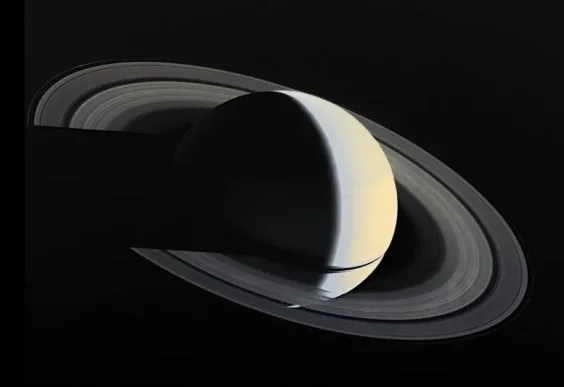
One final image shows Saturn as a crescent, with Voyager 1 turning away from the planet on its route toward Uranus. Seen after the closer views, the crescent has a different force: it marks the end of the encounter and the transition to a much longer journey. The flyby’s images remain a record of a brief passage that reshaped the view of Saturn’s moons and rings.
There’s a tension in that record. The spacecraft gathered images in a limited encounter, yet those images stayed useful as later missions revisited the questions they raised. The Saturn pictures weren’t a final account of the system. They were a starting point for interpreting its rings, moons and atmospheric features with better evidence over time.
What the continuing journey means
Voyager 1 has since crossed the heliosphere and entered interstellar space. The spacecraft is approaching one light-day from Earth—the distance light travels in 24 hours—and is expected to reach that mark on November 18. Its 50th anniversary of travel through space is due in September next year; the mission’s continuing journey now depends on how long the aging spacecraft can keep operating.
That distance gives the mission a human scale: even a signal traveling at the speed of light would take a full day to cross the gap. Yet the spacecraft’s future remains tied to a more immediate question—how long its aging systems can continue to function. The Saturn flyby offers a useful contrast: its images came from a concentrated encounter, while Voyager 1’s later story is defined by distance and endurance.
If you're working in this space, the lasting lesson is that a mission’s value doesn’t end when its close encounter does. Voyager’s Saturn views still help explain how scientific understanding changes as new observations arrive. A short visit. A long afterlife.



Discussion
Sign in to join the discussion.