Evidence links in-person contact to stronger collaboration and learning, while remote work offers real access benefits. The challenge is designing work around both.
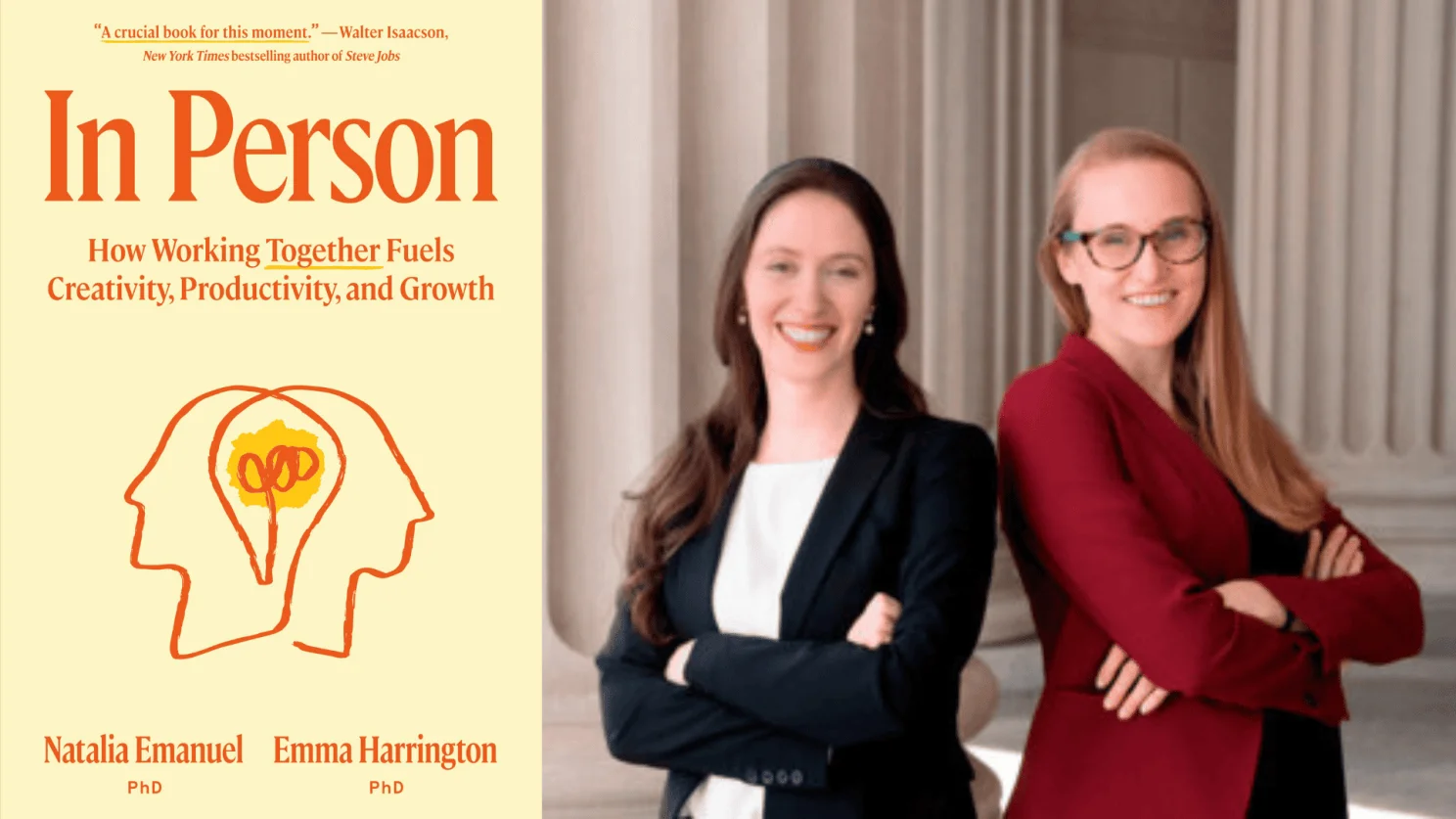
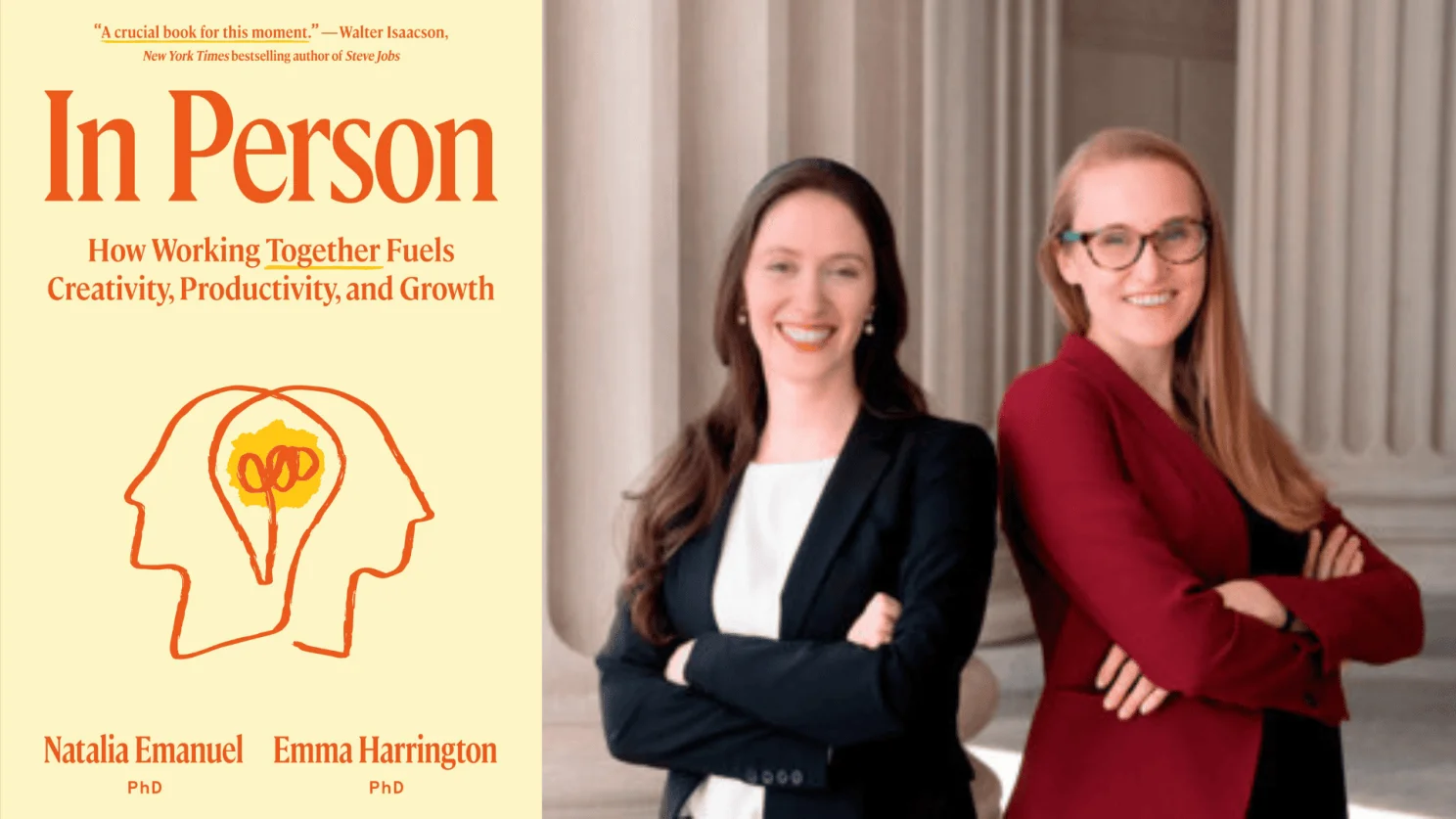
Natalia Emanuel (left) and Emma Harrington. Photo by Matt Mendelsohn
Remote work's hardest-to-replace resource may be the conversation nobody scheduled. Research by economists Natalia Emanuel and Emma Harrington argues that everyday contact across teams helps people exchange knowledge, learn from one another and improve their work. Their case for proximity is persuasive, but it doesn't settle the office debate: remote work can also remove barriers for people poorly served by conventional workplaces. The useful question is how to make collaboration possible without treating one work arrangement as right for everyone.
This excerpt is adapted from “In Person: How Working Together Fuels Creativity, Productivity, and Growth” by Natalia Emanuel, Ph.D. ’21, and Emma Harrington, Ph.D., ’21, published by Crown Currency, an imprint of the Crown Publishing Group, a division of Penguin Random House LLC.
Pixar designed for chance encounters
When Pixar planned its Emeryville headquarters, Steve Jobs saw the building itself as a way to shape how people worked together. The company had grown to 550 employees, but its staff were spread among office parks divided by busy roads. Writers, animators and engineers tended to work within their own groups. Even employees working on different films could become isolated from one another.
The consequences showed up in the work. Ralph Eggleston, art director on Toy Story, later attributed an early problem with Woody to “writer’s room banter.” The writers, separated from other disciplines, had made the character clever and abrasive rather than someone audiences could love. Investors who saw an early reel found Woody so “abrasive and unlikable” that they nearly withdrew their $30 million stake. The film ultimately became an Academy Award–winning hit, earning more than $400 million worldwide.
Jobs wanted Pixar’s new home to make cross-team contact easier. Director John Lasseter first imagined a traditional studio, with separate bungalows for each film. Jobs worried that this would reproduce the old divisions, and pressed for a single building for the whole company. A central atrium would draw staff together as they moved around the site.
Even the restroom plan served that purpose. When the architect asked how many facilities the building needed, Jobs proposed one large restroom in the atrium. Employees would have to cross paths on the way there. “We wanted to find a way to force people to come together, to create a lot of arbitrary collisions,” he told New York Times reporter Rick Lyman.
Lasseter, initially unconvinced, later said, “Steve’s theory worked from day one. I kept running into people I hadn’t seen for months. I’ve never seen a building that promoted collaboration and creativity as well as this one.” Pixar opened the headquarters in 2001, after Toy Story, A Bug’s Life and Toy Story 2 had established the studio’s reputation. Its later films included Finding Nemo, Up and WALL-E. Emanuel and Harrington point to the building as an example of how physical layout can encourage exchanges that formal meetings might miss.
Digital access doesn't guarantee cross-team contact
Remote tools make it technically easy to message a colleague in another department. The researchers argue that this ease can be misleading: People often contact fewer colleagues when they work apart, and the ties they do maintain can cluster within their immediate teams.
Microsoft’s move to remote work offered one way to observe that shift. Researchers examined employees’ emails, calendar invitations, instant messages and video calls, then mapped who communicated with whom. The resulting networks contracted as work went remote and became more siloed, with fewer connections between teams and departments.
That matters when solving a problem depends on knowledge held elsewhere. A sound designer shaping WALL-E’s interactions with his cockroach companion, Hal, could in principle have contacted a writer online. An animator might have asked an engineer how to make a character wobble instead of sway. But the researchers’ point is that a channel’s availability doesn't mean people will use it. In an office, a passing encounter can expose colleagues to a question before either has decided whom to ask.
That kind of contact can also improve work that looks individual from the outside. Drawing on data covering hundreds of thousands of workers, Emanuel and Harrington report that customer service representatives work faster and satisfy more customers when communication with colleagues is easy. Software engineers are less likely to introduce bugs when they discuss how their code fits into a larger system. For jobs built around teamwork, the value of those connections is even clearer.
Proximity has costs, and remote work has benefits
The authors also connect remote work with loneliness and weaker workplace friendships. They describe the office as the leading place where adults form friendships, and argue that shared effort can make work feel more meaningful than completing the same tasks alone. Their account of face-to-face interaction also draws on research suggesting that people’s brains synchronize more during in-person communication than during digital exchanges, and that direct contact supports trust and empathy.
Those findings deserve attention, but the case for proximity doesn't make the costs of office work disappear. Parents may have to coordinate care while meeting workplace demands. People with disabilities can encounter physical and logistical obstacles that consume energy before the workday gets underway. Working from home can reduce those burdens and help people focus on their jobs.
There is also a practical mismatch in many hybrid arrangements: Employees commute to an office only to spend the day on video calls with colleagues elsewhere. That setup preserves the travel while delivering little of the spontaneous interaction that office advocates value. In the United States, the share of workdays spent remotely rose from 6 percent in 2019 to roughly a quarter by 2026. Across OECD countries, remote work is now more than four times as common as it was before the pandemic.
Design work around the people who need to connect
The evidence, as presented by Emanuel and Harrington, makes a strong case that distance can weaken informal learning and cross-team ties. Pixar's atrium offers a vivid example of a company trying to change those patterns through design. But it doesn't establish that every employee or task benefits from the same schedule, or that a building can substitute for deliberate collaboration.
A more useful response is to identify which work benefits from being together, and make that contact worthwhile. Teams can use in-person time for joint problem-solving, mentoring and conversations across departments, rather than filling the day with calls that could happen anywhere. Remote options can preserve access for workers who face barriers in conventional offices, and help people balance work with responsibilities outside it.
The authors describe the choice as one that need not pit office advocates against remote workers. Their central argument is that companies should create more opportunities for meaningful contact among the people whose work depends on one another, while recognizing that employees also need connection beyond the workplace. The next test for hybrid work is whether organizations can turn that principle into schedules and spaces that support real collaboration.
Copyright © 2026 by Natalia Emanuel, Ph.D. and Emma Harrington, Ph.D.



Discussion
Sign in to join the discussion.