Astronomers have observed a red dwarf star slowly consuming a nearby brown dwarf, offering new insights into stellar interactions and material transfer.
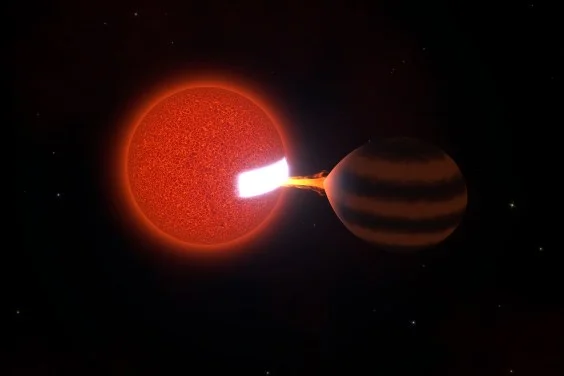
While celestial objects usually follow clear orbiting patterns, a recent observation revealed a rare instance of a red dwarf star siphoning material from a neighboring brown dwarf—an interaction described as exceedingly gradual. This process, known as accretion, is happening at a pace so sluggish that it may take billions of years for the brown dwarf to be completely depleted. This kind of celestial interaction isn't just a curiosity; it challenges existing perceptions of star behavior.
This brown dwarf, categorized as a "failed star," lies about 300 light-years away in the Milky Way and has been designated ZTF J0440+2325. Brown dwarfs are intriguing entities, larger than typical planets yet smaller than true stars. Often classified as the middle ground between planets and stars, they exhibit fascinating properties, yet lack the nuclear fusion necessary to shine like true stars. This specific brown dwarf weighs in at around 25 times the mass of Jupiter, while the red dwarf star is significantly heftier at approximately 85 times Jupiter's mass. Such ratios raise questions about gravitational dynamics and the mechanisms of material transfer.
Significance of the Discovery
For the first time, astronomers directly observed this slow accretion process, contrasting with typical expectations where interactions culminate in one body devouring the other outright. The traditional narrative has been that when stars interact with planets or brown dwarfs, one is inevitably consumed—quickly and spectacularly. Kevin Burdge, a co-author from MIT, highlighted this aspect by stating, “When we think of stars interacting with planets or brown dwarfs, the picture is always that the star eventually swallows the other thing.” His insights reflect a broader understanding in the field: many stellar events are far more complex and nuanced than textbook examples suggest. Instead, this discovery indicates an alternative approach in stellar relationships—a long-term gradual feeding process that allows both parties to coexist for extended periods.
The unique system was first identified through a peculiar triangular light pattern observed at the Palomar Observatory in California. Astronomical anomalies like this one often serve as the breadcrumbs leading researchers to deeper insights. This unusual signal hinted at the combustion from the red dwarf as it consumed the brown dwarf. Researchers later deduced that the peak of the triangular signal correlated with the star's consistent drawing in of material from the brown dwarf. Such findings could prompt a rethinking of theories around gravitational interactions in space, especially in binary systems where differing stellar masses are common.
Material Transfer Insights
Interestingly, the brown dwarf ejects material into the star at an astounding rate—about 40 million dump trucks' worth of matter every second. If you're working in this space, consider the implications: while this number sounds colossal, it's relative to the star's immense mass. This raises questions about what happens to the ejected material—does it vaporize, contribute to star formation, or perhaps feed the stellar environment? Such interactions could illuminate aspects of stellar life cycles previously thought to be independent or unconnected.
This unique observation challenges the widely held notion that interactions between stellar bodies are primarily destructive. Instead, researchers are beginning to recognize that there's more nuance involved. While it may seem mundane on the surface, these slow-eating stars could pave the way for new theories about stellar evolution and the fate of both stars and their companions. With this unprecedented insight into a slow-eating stellar system, astronomers are eager to study more such phenomena. Given that these interactions unfold over billions of years, there’s ample opportunity for further exploration and understanding of the behaviors of stellar bodies.
Implications and Future Outlook
This discovery has wide-ranging implications for our understanding of star behavior and interactions in the cosmos. Far from being mere oddities, slow accretion processes like this could represent an overlooked category of astrophysical phenomena that warrants further examination. The prevailing models of star evolution may need to be reassessed in light of such evidence. Are we witnessing a broader evolutionary trend among stars and brown dwarfs that has been ignored?
Astronomers are likely to focus on similar systems in the Milky Way, using this newfound knowledge to seek out other examples of gradual accretion. There’s an opportunity to refine detection methods that could pinpoint more of these elusive interactions. This could deepen our understanding of how stars consume and recycle material that may play a critical role in star formation and the lifecycle of galaxies. (And this is the part most people overlook.) The findings challenge not only individual models but the entire framework of how we understand interactions in the cosmos.
As these studies continue, the astronomical community may reshape the narrative surrounding stellar interactions. Researchers will keep an eye on systems exhibiting similar characteristics, and we may uncover a wealth of knowledge about the fundamental processes that govern the behavior of not just these celestial bodies, but potentially countless others across the universe.
Lead Image: Aaron Householder/MIT

Discussion
Sign in to join the discussion.