Quantum computing shows potential but faces hurdles before achieving classically verifiable advantage and practical uses in various fields.
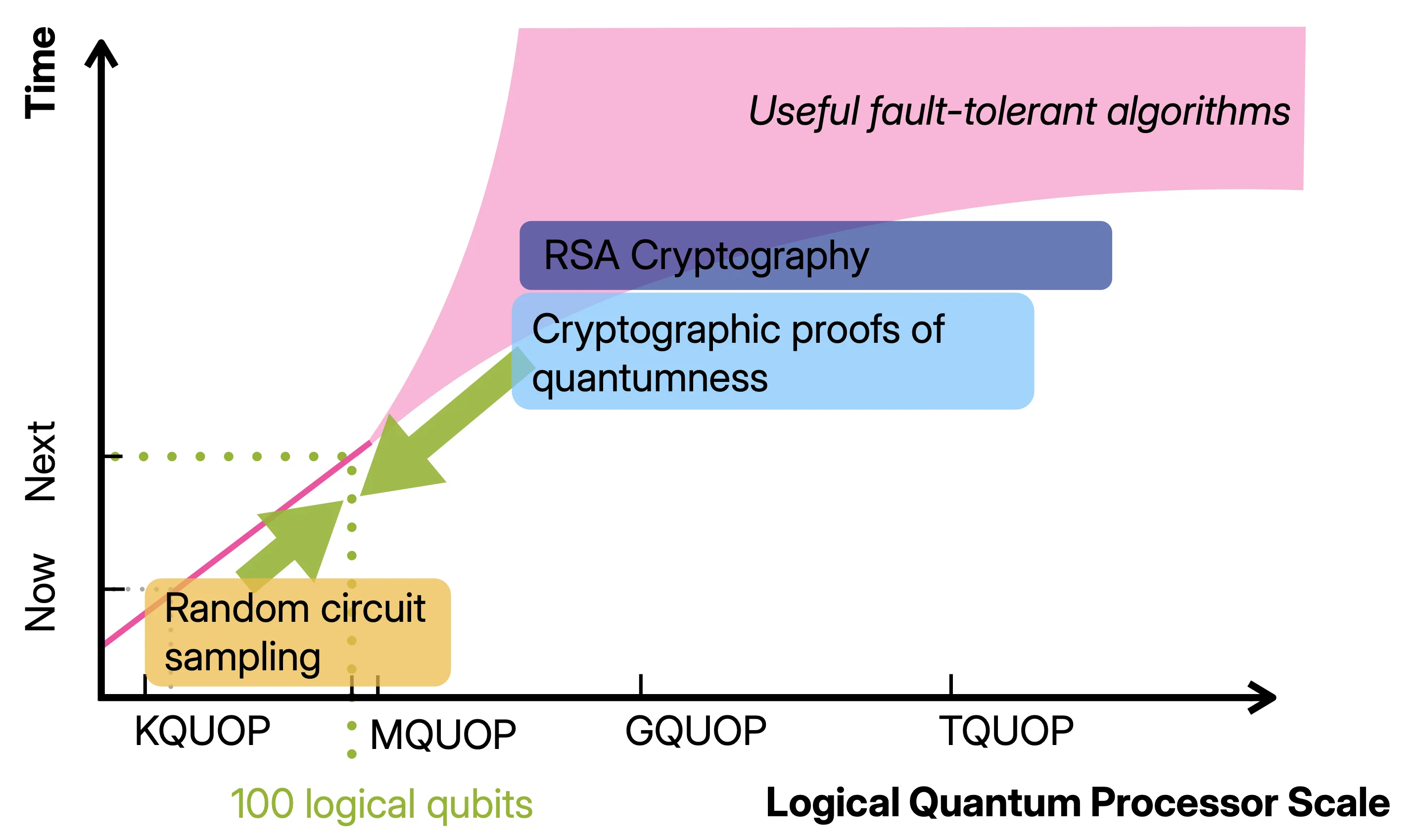
Understanding Quantum Advantage: The Current State of Play
We are at a pivotal moment in the journey toward harnessing the full potential of quantum computing. Evidence now strongly suggests that quantum computersThe Ambitious Road Ahead: Aiming for Classically Verifiable Quantum Advantage
As we look ahead, an essential milestone emerges: achieving classically verifiable quantum advantage. Reaching this point won’t just hinge on advancing the hardware capabilities of quantum devices; it’ll also necessitate the discovery of advantage schemes that allow for classical verification within the confines of our existing resources. What makes this goal both appealing and attainable? For starters, the current verification methods, especially in randomized circuit sampling (RCS) experiments, have glaring weaknesses. In earlier posts, I delved into this: relying on cross-entropy benchmarking can be easily manipulated and is only effectively measured within a limited operational range. Ideally, an experiment demonstrating quantum advantage should include a straightforward process to convincingly confirm that an actual quantum computation occurred. In a truly classically verifiable quantum advantage scenario, a classical verifier would devise challenge circuits to send to a quantum server. Upon receiving classical output from those circuits, the verifier must be able to ascertain, with strong confidence, that quantum computing underpinned the results returned by the server. This transition from experimental physics to an applicable protocol—one that prioritizes trust in the server's computations—might unlock the first true applications of quantum technology. Consider the potential for quantum-generated random numbers that could be certified for their authenticity. Currently, there's no equivalent classical approach capable of achieving such a feat. It's important to recognize the existing knowledge around proofs of quantumness, which enable us to verifiably demonstrate quantum processes (see [PoQ](https://doi.org/10.1109/FOCS.2018.00038) for example). Although these cryptographic proofs provide robust security founded upon well-established principles, they require resources that rival those needed for classical factoring processes. On the contrary, the kinds of computations we can currently execute—primarily RCS—are efficient but lack verifiability. The 100-logical-qubit regime could bridge this gap between efficiency and reliability, but exploring concepts like classically verifiable advantage is crucial. We need to uncover quantum advantage schemes that are not only efficient like RCS but also verifiable in a classical context.
Graph States and Sampling Efficiency
Graph states represent a compelling approach in quantum computing, particularly when generated using controlled-Z (CZ) gates based on a graph's edges from an initial all- |+⟩ state. The subsequent application of single-qubit Z-rotations, followed by measurement in the X basis, positions this as a valid interaction within the category of intermediate quantum polynomial (IQP) circuits. The beauty of this setup lies in its symmetries, defined by locally rotated Pauli operators, allowing us to derive these symmetries through minimal measurements — even mentally averaging the expectation values proves efficient. Here’s the kicker: leveraging 100 logical qubits, we can generate samples that challenge classical computation's boundaries. The task becomes less daunting when you consider that obtaining these outputs doesn't necessitate repetitive measurement setups. However, this efficiency does impose certain limitations, as we require disparate measurements for both sampling and verification.Bell Sampling Simplified
Now, let’s shift gears to Bell sampling, an exciting but complex alternative. The crux of Bell sampling is its dual measurement requirement. Imagine verifying a set of classically complex samples simply by using those very samples. This scenario unfolds when we analyze two copies of a state |C⟩ from a random circuit. Due to its invariance under swaps between the two copies, the expectation value of the SWAP operator becomes crucial for deducing the purity of our output state. Interestingly, this relationship lies at the heart of measuring "hardness" for classical simulators. When samples from the state |C⟩ ⊗ |C⟩ are measured in the Bell basis, the SWAP operator’s expectation can be discerned almost elegantly amidst these measurements. It's an endeavor that promises rich dividends, as the purity and fidelity indicators align under the right random circuit assumptions. In essence, if we can execute a circuit randomly, it’s reasonable to expect that measuring its purity serves as a near-accurate representation of its logical fidelity.Fault-Tolerant Quantum Circuits
Transitioning to fault-tolerant circuits, we dive into a pivotal element of quantum advantage experiments. Every point in these circuits harbors a set of natural symmetries, primarily the stabilizers respective to the encoding scheme used. By routinely measuring these stabilizers mid-execution, we can draw directly from this data to evaluate the logical state’s quality. Surprisingly, it's efficient to estimate logical fidelity from the expectation values of these stabilizers, even in quantum advantage circumstances. In terms of scaling up, running fault-tolerant IQP circuits within this regime becomes straightforward, given that the syndromes offer a pathway to fidelity estimation. The situation presents a watershed moment for quantum computing, and if experiments involving 100 logical qubits can be realized, they may unlock opportunities not just for theoretical exploration but also for practical applications.Towards Practical Applications
The ability to perform sampling with explicit symmetries clarifies the landscape for certifying quantum computations. Herein lies a necessity for trusted experimenters: while generating valid classical samples is relatively simple, verifying them demands a certain level of confidence in the experimental integrity. As we explore ways to embed "hidden secrets" within quantum outputs, the idea of certifiable random number generation emerges. These schemes pivot on sampling distributions from quantum circuits designed with clandestine elements, allowing classical validation of outcome authenticity. Yet, the overarching question remains: How can we create efficient verification processes for untrusted quantum servers? The challenge gleaned from these theoretical discussions, particularly concerning IQP circuits, is tantalizing. The goal is to bridge the widening gap between classical and quantum realms, particularly focusing on creating a setup that would permit classical certification of quantum advantage — a notion that has far-reaching implications for real-world applications. Ultimately, deciphering the mysteries behind certain quantum output distributions takes center stage as we plan for future milestones within the 100 logical qubit framework. The exploration of these quantum circuits signals a pivotal leap forward, positioning us closer to practical quantum implementations that boast operational viability.A New Era of Quantum Promise
In wrapping up this series, it’s evident we’re at a significant juncture in quantum computing. The evidence showing that quantum advantage is not just theoretical but observable is compelling, particularly through recent RCS experiments. Sure, there are still unresolved questions that we can’t overlook, but if you appreciate the nuances of physics-based evidence, the case is stronger than ever.
As we witness rapid advancements, the collective ambition of the quantum community pushes towards a clear objective: achieving fault-tolerant logic at the 100-qubit threshold. This isn’t just an exercise in complexity; it’s about establishing verifiable and demonstrable benefits in real-world applications. If successful, these future experiments will resolve many of the current ambiguities surrounding quantum durability and ultimately facilitate practical algorithms that can genuinely leverage quantum advantages.
Acknowledgments and Future Directions
Before we conclude, a heartfelt thank you goes out to Spiros Michalakis, John Preskill, and Frederik Hahn; their insights have been invaluable in refining these discussions. Their contributions reflect the collaborative spirit that is essential in this fast-paced domain.
Looking ahead, the ongoing development in quantum circuits will be pivotal. There’s a palpable excitement about the potential for error correction and the rigorous approaches needed to establish credible advantages. For those invested in this evolving technology, remaining vigilant and engaged with these advancements will not only enhance your understanding but also prepare you for the future that quantum computing is shaping.



Discussion
Sign in to join the discussion.