Examining personal experiences highlights our relationship with entropy, suggesting that amid chaos, we find meaning and purpose in life.
In my journey through academia, particularly during my PhD at Caltech, I was fortunate to share time with friends like Jeremy, who regularly hosted dinner parties. His culinary endeavors often turned into communal events, inviting friends to cook or simply enjoy the chaos lingering in his kitchen—one where pots and pans were strewn about like signs of culinary triumph. I found myself drawn to the mess, unable to resist the urge to restore order. Jeremy, an accomplished applied physicist, remarked on my knack for "decreasing entropy." To me, it was simply part of my nature.
This tendency wasn’t new; I’d been inclined toward order since childhood. I vividly remember Fridays in fourth grade, when my classmates and I had to clean our desks. While others hurried outside to the playground, I’d often tidy up my neighbor’s messy desktop as well. The idea of messiness—an untidy desk or a cluttered kitchen—bothered me, much like a natural disaster leaves chaos in its wake. The satisfaction from organizing, whether a handful of school supplies or complex theoretical models, motivated my paths through both academic and personal realms.

Ironically, this inclination toward order mirrors a broader scientific concept: entropy, often described as a measure of disorder. If we consider a kitchen festooned with utensils post-meal, the multitude of configurations in which these items can exist illustrates entropy. The concept of entropy implies that most arrangements are disorderly rather than tidy, correlating with the idea that high entropy equates to messiness. Thus, when Jeremy acknowledged my cleaning efforts, he was recognizing my contribution to order amidst chaos.

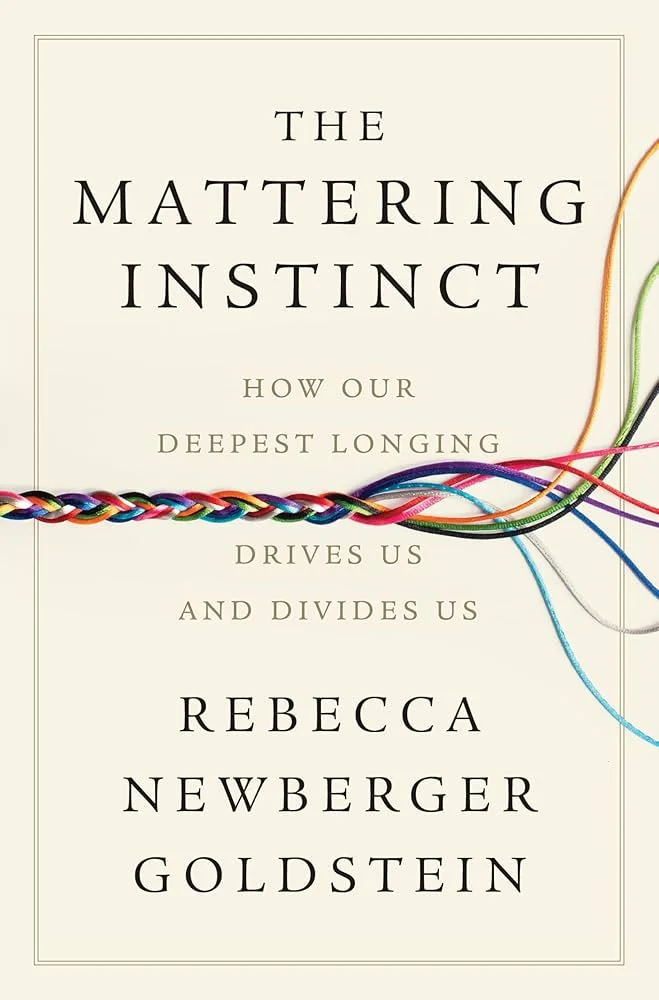
My thoughts on entropy were intrigued by Rebecca Newberger Goldstein's recent book, The Mattering Instinct. Rebecca, a philosopher and writer who I was fortunate to encounter through my former mentor Marcelo Gleiser, explores the innate human desire to feel significant. This longing drives us to seek stability in our lives, a theme echoed throughout her analysis of survival and flourishing. People expend tremendous energy securing lives, with a desire for validation woven throughout our actions.
One of the key aspects of our existence is the necessity to combat entropy. The second law of thermodynamics asserts that entropy in a closed system either increases or remains constant. As particles disperse and temperatures even out, disorder reigns. However, our existence and adaptability rely on keeping our internal systems ordered—maintaining low entropy amidst an inherently chaotic universe. Rebecca's premise is that humans struggle against entropy, symbolizing our fight for existence.

Yet, as someone steeped in thermodynamics, I also find beauty in entropy. It provides a framework for understanding the flow of time, quantifying uncertainty, and exploring efficiency in tasks. The intricate nature of entropy reflects a delicate balance of tension and complexity, explaining aging and decay in our world. When I began my PhD, I envisioned dedicating my career to understanding entropy, recognizing both its challenges and its contributions to our lives.
To reshape the narrative surrounding entropy, I would draw inspiration from authors like Terry Pratchett. His work humanized themes of mortality, inviting empathy and understanding rather than conflict. Though I won’t anthropomorphize entropy, I aim to shift perspectives about our relationship with it. Rather than seeing ourselves as adversaries of entropy, we can recognize that we collaborate with it. By generating entropy in our environments, we balance the entropy we manage internally. The partnership we form with entropy, then, becomes fundamental to our survival and well-being.

Take the example of working at a desalination plant. Here, the task of reducing high-entropy saltwater to yield fresh water illustrates this principle well. To achieve that goal, one must create additional entropy elsewhere. Consuming energy—such as a breakfast waffle—transforms into work that dissipates heat, raising the entropy of the surrounding air. Thus, our very actions to create order in certain domains inadvertently raise disorder in others, embodying the complex interplay of existence.
This concept echoes throughout our lives; we produce entropy continuously, reinforcing our interconnectedness with the environment. Organisms have an intrinsic ability to generate entropy, enabling life to flourish. As we reflect on this cooperation with entropy, we realize our existence hinges on it. This awareness resonates deeply, as illustrated in my studies of quantum information theory and thermodynamics throughout my academic career.
Upon finishing Goldstein's book, I realized these reflections about entropy and the mattering instinct converge seamlessly. As I rush to return to my beloved task of cleaning and organizing—whether it be dishes or the broader universe—I reaffirm this life-long engagement with entropy. My partner in this endeavor is not merely disorder, but a vital aspect of existence and fulfillment.

With sincere gratitude to Jeremy, for both his companionship and his delectable meals.
I also ensured my neighbor left school with all the sweaters he brought from home to avoid clutter. To this day, these ideas of order and meaning continue to guide me.



Discussion
Sign in to join the discussion.